
CUETMOCK
  • Pricing
  • Mentors
Log inStart freeStart free mocks→

First test, then trust

Try a free CUET mock test.

Join 5,00,000+ students who rehearsed exam day on the exact NTA screen before sitting CUET. On the web and on Android.

Start free mocks →Get the Android app
CUETMOCK

India's #1 CUET Mock Test Platform. Original NCERT-based questions on the exact NTA exam screen — trusted by 5,00,000+ students since CUET 2022.

Get it onGoogle PlayScan to download the CUETMOCK app

Mock tests

  • CUET mock test series
  • Commerce mocks
  • Humanities (Arts) mocks
  • Science mocks
  • Languages & GAT mocks
  • Free practice questions
  • Pricing

Resources

  • CUET exam guide
  • CUET syllabus
  • Universities accepting CUET
  • Expert blogs
  • News & notifications
  • Webinars & counselling
  • CUET score calculator
  • How we estimate your rank
  • FAQs

Company

  • About us
  • Our leadership & team
  • Our toppers
  • Mentors
  • For schools
  • Contact us
  • Terms
  • Privacy
  • Refund policy

Talk to us

+91 7696 6630 56info@cuetmock.comWhatsApp us

Our other platforms

  • JEE Mock — For IIT-JEE aspirants
  • NEET Mock — For NEET aspirants

Newsletter

Exam updates, study material and offers — no spam.

© 2026 NYC Ventures Pvt. Ltd.

701-702, Royal Business Park, Zirakpur, Punjab - 140603

  • Terms of use
  • Privacy policy
  • Refund policy
  • Contact us

iCUETMOCK is an independent preparation platform, not affiliated with the National Testing Agency (NTA). Always check exam details on the official NTA website.

  • Home
  • Mock tests
  • CUET guide
  • Pricing
  • Log in
Home/Practice questions/Biology
BiologyHuman Reproduction

Arrange the following structures of spermatogenesis in the correct se…

Arrange the following structures of spermatogenesis in the correct sequence.

A. Primary spermatocyte

B. Spermatogonia

C. Spermatid

D. Secondary spermatocyte

Choose the correct answer from the options given below:

Answer & explanation+

Correct answer: option 4

The correct answer is Option (4) → B, A, D, C

(B) Spermatogonia — First. These are the diploid male germ cells (46 chromosomes) on the inside wall of the seminiferous tubules. They multiply by mitosis.

(A) Primary spermatocyte — Second. Some spermatogonia become primary spermatocytes. These are still diploid, and they enter meiosis.

(D) Secondary spermatocyte — Third. The first meiotic division (reduction division) gives two haploid secondary spermatocytes. Each has 23 chromosomes.

(C) Spermatid — Fourth. The second meiotic division gives four haploid spermatids. These later change into sperms by spermiogenesis.

Note: A similar question was also asked in CUET (UG) 2026 on 07-06-2026 (Slot 2) and on 06-06-2026 (Slot 1).

NCERT Extract:
Gametogenesis – “… In testis, the immature male germ cells (spermatogonia) produce sperms by spermatogenesis that begins at puberty. The spermatogonia (sing. spermatogonium) present on the inside wall of seminiferous tubules multiply by mitotic division and increase in numbers. Each spermatogonium is diploid and contains 46 chromosomes. Some of the spermatogonia called primary spermatocytes periodically undergo meiosis. A primary spermatocyte completes the first meiotic division (reduction division) leading to formation of two equal, haploid cells called secondary spermatocytes, which have only 23 chromosomes each. The secondary spermatocytes undergo the second meiotic division to produce four equal, haploid spermatids (Figure 2.5).”
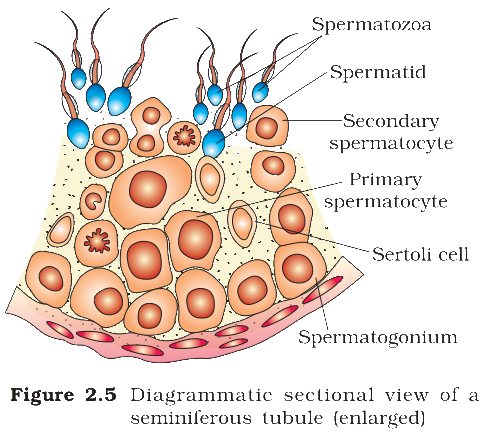
Textbook figure

Advertisement

Practise more on Human Reproduction

Chapter-wise mocks on the real NTA exam screen, with solutions and your rank. Your first mocks are free.

Start free mocks →

Advertisement

Next questions

  1. The reagent used in the Stephen reaction isChemistry · Organic: Aldehydes, Ketones and Carboxylic Acids
  2. In India, human activities cause which of the following land degradations?A. Degraded shifting cultivation areaB. Mining and industrial was…Geography · India-People and Economy: Geographical Perspective on selected issues and Problems
  3. The most common objections to advertising include:A. Inculcates social valuesB. Adds to the costsC. Confuses the sellersD. Encourages sale…Business Studies · Marketing
  4. KRISHNA Ltd. has given you the following information:ParticularsRs.Machinery as on April 01, 20241,50,000Machinery as on March 31, 20251,60…Accountancy Part B · Cash Flow Statement
  5. Match List - I with List - IIList - IList - II(a)The portion of authorised capital of a company which can be called during winding up(i)Oth…Accountancy Part A · Accounting for Shares
  6. Match the LIST-I with LIST-IILIST-I(Type of Port)LIST-II(Name of Port)(A)Oil Port(I)Maracaibo(B)Port of Call(II)Rotterdam(C)Entrepot Ports(…Geography · Fundamentals of Human Geography: International Trade
  7. Select the sentence in which the phrasal verb TURN DOWN has been used correctly.English · Grammar: Phrasal Verb
  8. In a certain code, three statements I, II and III are written.I. 'pit na tac' means 'come and go'II. 'ja ta da' means 'you are good'III. 'n…General Aptitude Test · Verbal Reasoning
  9. The scientist who developed a method for sequencing the DNA fragments was:Biology · Molecular Basis of Inheritance
  10. Plants fix Sun’s radiant energy to make food from simple inorganic materials. The amount of energy fixed by plants is:Biology · Ecosystem