What would be the geometrical shape of [NiCl4]2− and [PtCl4]2− compounds?
Answer & explanation
Correct answer: option 4
The correct answer is Option (4) → [NiCl4]2- is tetrahedral while [PtCl4]2- is square planar
A complex with coordination number 4 is either tetrahedral or square planar. By valence bond theory, the shape depends on the orbitals the metal ion uses for bonding:
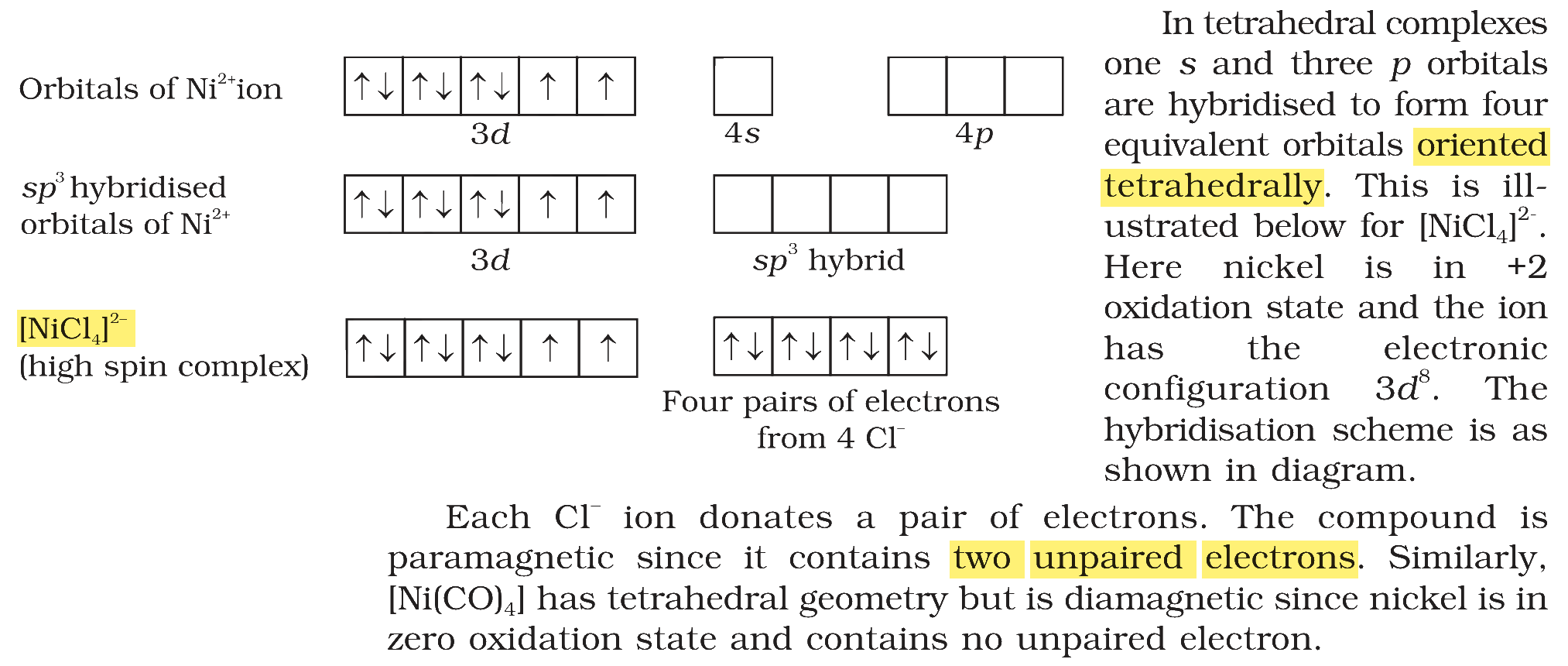
sp3 hybridisation (one s and three p orbitals) gives a tetrahedral complex.
dsp2 hybridisation (one inner d, one s and two p orbitals) gives a square planar complex. This is possible only when the d electrons pair up and leave one inner d orbital empty.
In both ions the four \( \ce{Cl^-} \) ligands give a charge balance of x + 4(−1) = −2, so the metal is in the +2 state, and both metal ions are d8.
[NiCl4]2−: Ni (Z = 28) is [Ar]3d84s2; losing the two 4s electrons gives Ni2+: 3d8. \( \ce{Cl^-} \) is a weak field ligand, so the two unpaired 3d electrons do not pair up. No 3d orbital is free, so Ni2+ uses its 4s and 4p orbitals: sp3, tetrahedral, paramagnetic with two unpaired electrons.
[PtCl4]2−: Pt (Z = 78) is [Xe]4f145d96s1; losing the 6s electron and one 5d electron gives Pt2+: 5d8. The 5d orbitals are larger and the crystal field splitting of 5d metals is much greater than that of 3d metals, so the eight electrons pair up even with a weak ligand like \( \ce{Cl^-} \). One 5d orbital is left empty: dsp2, square planar, diamagnetic.
So [NiCl4]2− is tetrahedral and [PtCl4]2− is square planar.
Why the other options are incorrect
Option (1) Both [NiCl4]2- and [PtCl4]2- are square planar. — Incorrect. With the weak field \( \ce{Cl^-} \) ligand, Ni2+ keeps two unpaired 3d electrons, so no inner d orbital is free for dsp2. A square planar Ni2+ complex needs a strong field ligand, as in [Ni(CN)4]2−.
Option (2) Both [NiCl4]2- and [PtCl4]2- are tetrahedral. — Incorrect. The 5d8 ion Pt2+ pairs its electrons even with chloride, so [PtCl4]2− is square planar, not tetrahedral.
Option (3) [NiCl4]2- is square planar while [PtCl4]2- is tetrahedral. — Incorrect. This gives the two shapes the wrong way round: the 3d ion with a weak ligand is tetrahedral and the 5d ion is square planar.
NCERT (2026-27 edition):
Definitions of Some Important Terms Pertaining to Coordination Compounds – “(f) Coordination polyhedron
The spatial arrangement of the ligand atoms which are directly attached to the central atom/ion defines a coordination polyhedron about the central atom. The most common coordination polyhedra are octahedral, square planar and tetrahedral. For example, [Co(NH3)6]3+ is octahedral, [Ni(CO)4] is tetrahedral and [PtCl4]2– is square planar.”
Valence Bond Theory