
Which of the following are true for Daniell cell?
(A) The emf of the cell is 1.1 V when concentration of Zn2+ and Cu2+ is unity.
(B) The cell converts electrical energy into chemical energy.
(C) Current flows from anode to cathode.
(D) Oxidation takes place at the anode and reduction occurs at the cathode.
Choose the correct answer from the options given below:
Answer & explanation
Correct answer: option 3
The correct answer is Option (3) → (A) and (D) only
The Daniell cell is a galvanic cell: it converts the chemical energy of a spontaneous redox reaction into electrical energy. Zinc is oxidised at the anode and \( \ce{Cu^{2+}} \) ions are reduced at the cathode:
\( \displaystyle \ce{Zn(s) + Cu^2+(aq) -> Zn^2+(aq) + Cu(s)} \)
\( \displaystyle E^\circ_{cell}=E^\circ_{\ce{Cu^2+/Cu}}-E^\circ_{\ce{Zn^2+/Zn}}=0.34-(-0.76)=1.10\ \mathrm{V} \)
(A) The emf of the cell is 1.1 V when concentration of Zn2+ and Cu2+ is unity. Correct. With both ion concentrations at 1 mol L−1, the cell is under standard conditions and its emf is E°cell = 1.10 V.
(B) The cell converts electrical energy into chemical energy. Incorrect. That is what an electrolytic cell does. The Daniell cell converts chemical energy into electrical energy.
(C) Current flows from anode to cathode. Incorrect. Electrons flow from the zinc anode to the copper cathode in the external circuit. Current is taken in the opposite direction, from the cathode (copper) to the anode (zinc).
(D) Oxidation takes place at the anode and reduction occurs at the cathode. Correct. \( \ce{Zn -> Zn^2+ + 2e^-} \) takes place at the anode and \( \ce{Cu^2+ + 2e^- -> Cu} \) at the cathode.
NCERT (2026-27 edition):
Electrochemical Cells – “We had studied the construction and functioning of Daniell cell (Fig. 2.1). This cell converts the chemical energy liberated during the redox reaction
\( \displaystyle \ce{Zn(s) + Cu^2+(aq) -> Zn^2+(aq) + Cu(s)} \) (2.1)
to electrical energy and has an electrical potential equal to 1.1 V when concentration of Zn2+ and Cu2+ ions is unity (1 mol dm–3). Such a device is called a galvanic or a voltaic cell.”
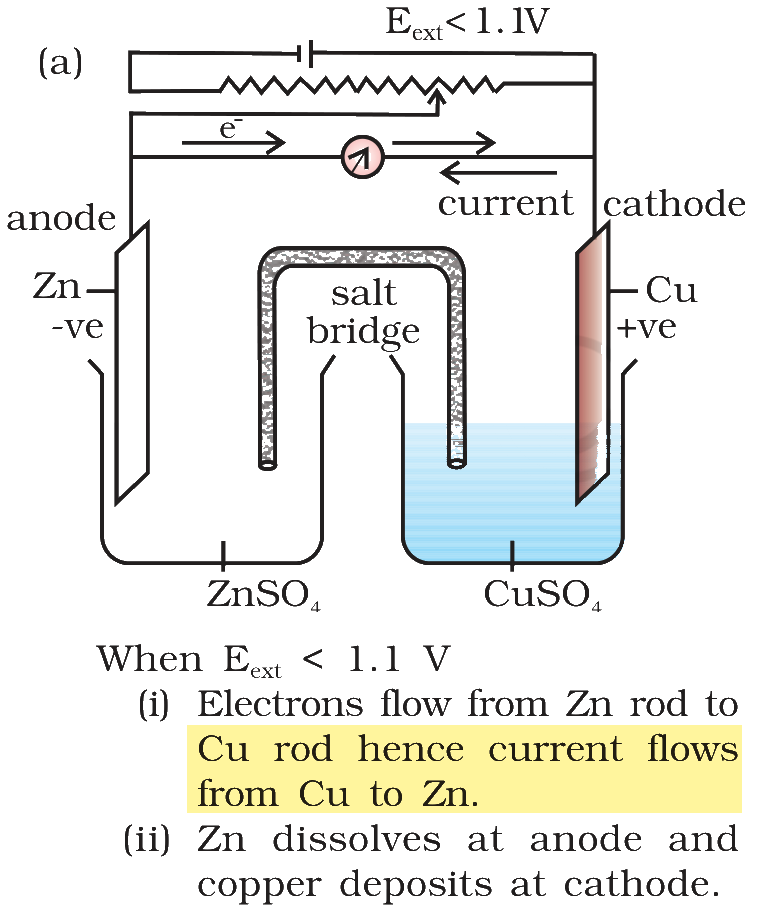
Galvanic Cells – “… In a galvanic cell, the half-cell in which oxidation takes place is called anode and it has a negative potential with respect to the solution. The other half-cell in which reduction takes place is called cathode and it has a positive potential with respect to the solution.”