Match List-I with List-II
| List-I (Cases for payment of realization expenses) | List-II (Journal entry) | ||
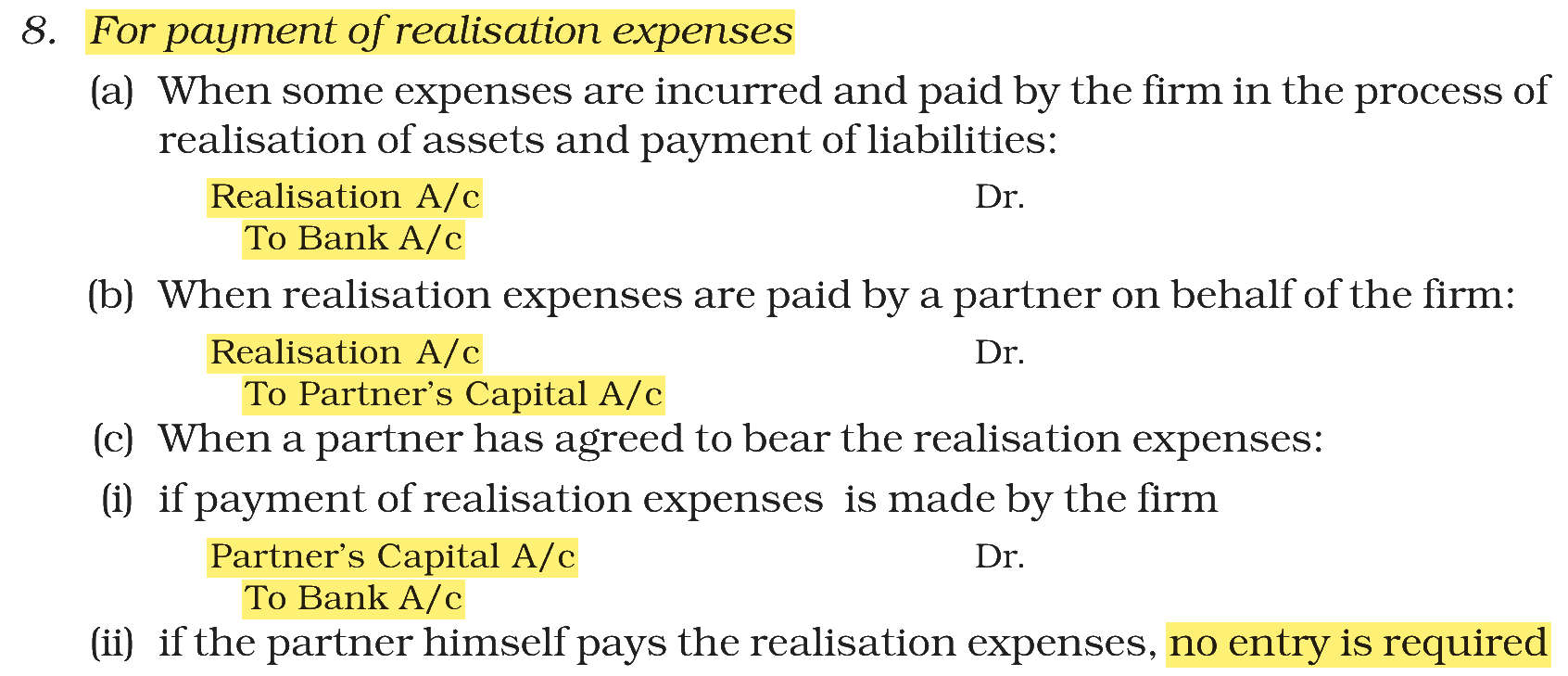
| (A) | When realisation expenses are incurred and paid by the firm | (I) | Realisation A/c Dr. To Partner's Capital A/c |
| (B) | When realisation expenses are paid by a partner on behalf of the firm: | (II) | No entry is required |
| (C) | When a partner has agreed to bear the realisation expenses and the realisation expenses are paid by the firm | (III) | Realisation A/c Dr. To Bank A/c |
| (D) | When a partner has agreed to bear the realisation expenses and the partner himself pays the realisation expenses. | (IV) | Partner's Capital A/c Dr. To Bank A/c |
Choose the correct answer from the options given below:
Answer & explanation
Correct answer: option 2
The correct answer is Option (2) → (A) - (III), (B) - (I), (C) - (IV), (D) - (II)
For each case ask two things: who pays the expense, and who has to bear it.
(A) Expenses incurred and paid by the firm — this matches (III) Realisation A/c Dr. / To Bank A/c. The firm pays out of its bank balance, and the expense is charged to the Realisation Account.
(B) Expenses paid by a partner on behalf of the firm — this matches (I) Realisation A/c Dr. / To Partner’s Capital A/c. The expense is still the firm’s, and the firm owes the partner what he paid, so his capital account is credited.
(C) A partner has agreed to bear the expenses and the firm pays them — this matches (IV) Partner’s Capital A/c Dr. / To Bank A/c. The cost is his, so it is debited to his capital account and not to the Realisation Account.
(D) A partner has agreed to bear the expenses and pays them himself — this matches (II) No entry is required. No money of the firm moves, and the firm owes him nothing.
NCERT (2026-27 edition):
|