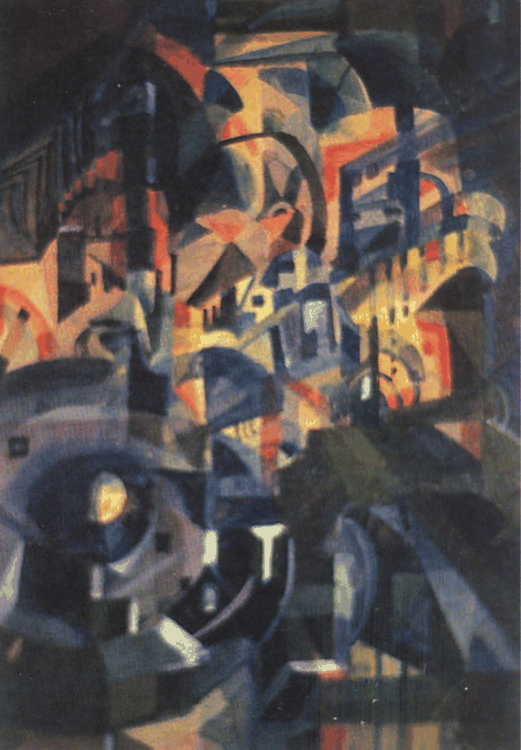
Observe the image given below and answer the following questions.
Choose the correct fact about the painting.
Answer & explanation
Correct answer: option 2
The correct answer is Option (2) → Artist used a syntax of Cubism in this painting to render his ideas.
This painting is City in the Night, a watercolour by Gaganendranath Tagore. He was one of the early Indian painters who used the language and syntax of Cubism, a style that breaks forms into many-sided shapes seen from several viewpoints.
Option (1) The artist is inspired by the folk art of Bengal — Incorrect. This is true of Jamini Roy, who collected the pats, the folk paintings of Bengal. Gaganendranath built this painting on Cubism, not on folk art.
Option (2) Artist used a syntax of Cubism in this painting to render his ideas. — Correct. The diamond-shaped planes, jagged edges and many viewpoints of the city come from Cubism.
Option (3) The artist used a lyrical quality of calligraphy in every line. — Incorrect. This is said of Abdul Rehman Chughtai’s Radhika, where the figure is drawn with graceful, flowing lines. City in the Night is made of sharp geometric planes.
Option (4) The artist created a visual sense of Tantric philosophy. — Incorrect. This is the work of G. R. Santosh, whose abstract paintings show the cosmic union of purusha and prakriti of Tantric thought.
NCERT (2026-27): “City in the Night This is a watercolour painting made by Gaganendranath Tagore (1869 –1938) in 1922. He was one of the earlier Indian painters, who made use of language and syntax of Cubism to render his ideas. The inner experiences of turbulence are externalised through a blend of allegorical and formal, transforming the static geometry of Analytical Cubism into an expressive apparatus.…”
City in the Night |