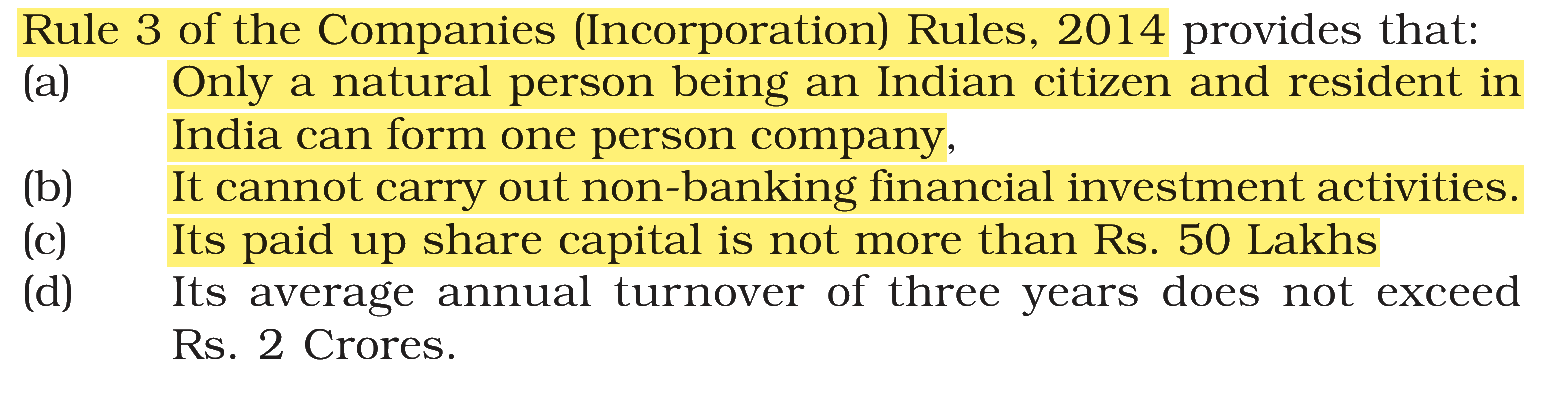
Which of the following are correct with respect to Rule 3 of the Companies (Incorporation) Rules, 2014 for One Person Company?
(A) Only a natural person being an Indian citizen and resident in India can form one person company.
(B) It cannot carry out non-banking financial investment activities.
(C) Its paid up share capital is not more than Rs. 50 Lakhs.
(D) Its average annual turnover of three years does not exceed Rs. 5 Crores.
Choose the correct answer from the options given below:
Answer & explanation
Correct answer: option 1
The correct answer is Option (1) → (A), (B) and (C) only
A One Person Company is a company with only one person as its member. Rule 3 of the Companies (Incorporation) Rules, 2014 lays down who can form one and the limits it works within.
(A) Only a natural person being an Indian citizen and resident in India can form one person company. Correct. A company or other artificial person cannot form one.
(B) It cannot carry out non-banking financial investment activities. Correct. This activity is barred for a One Person Company.
(C) Its paid up share capital is not more than Rs. 50 Lakhs. Correct. This is the capital limit in the rule.
(D) Its average annual turnover of three years does not exceed Rs. 5 Crores. Incorrect. The turnover limit in Rule 3 is Rs. 2 Crores. Only the figure was changed, and a true line became false. Read every number before you mark the answer.
Note: The rules for a One Person Company have changed since the textbook was written. From 1 April 2021 (Companies (Incorporation) Second Amendment Rules, 2021) the limits of Rs. 50 Lakhs on paid up share capital and Rs. 2 Crores on average annual turnover no longer apply, and an Indian citizen who is not resident in India can also form one, while the stay needed to count as resident is 120 days instead of 182. NTA’s question follows the textbook limits, under which (A), (B) and (C) are correct and (D), with Rs. 5 Crores, is not. So the answer is Option (1).
NCERT (2026-27 edition):
|