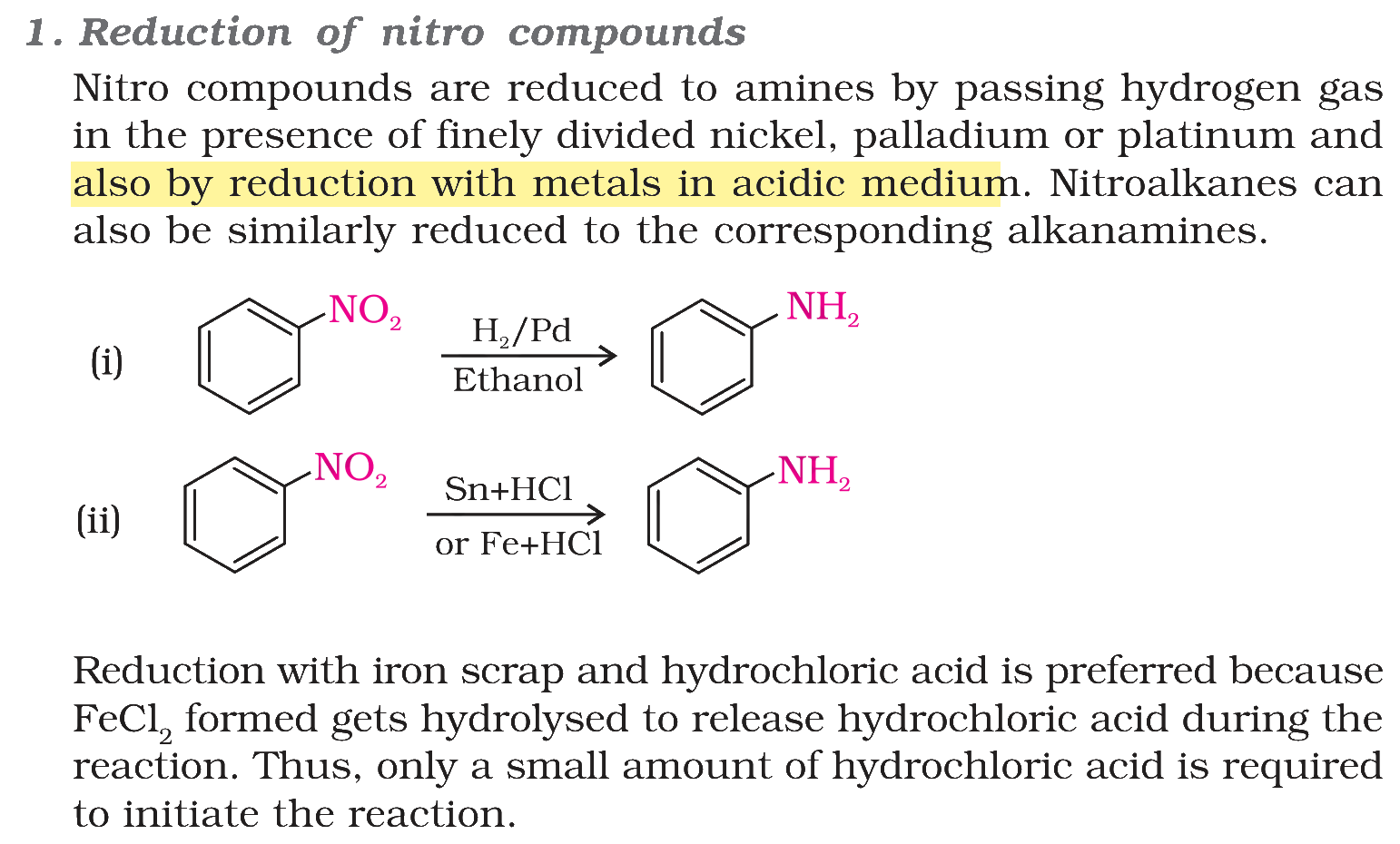
When benzene diazonium fluoroborate is heated with aqueous sodium nitrite in the presence of Cu, followed by heating with iron and concentrated hydrochloric acid, yields
Answer & explanation
Correct answer: option 3
The correct answer is Option (3) → Aniline
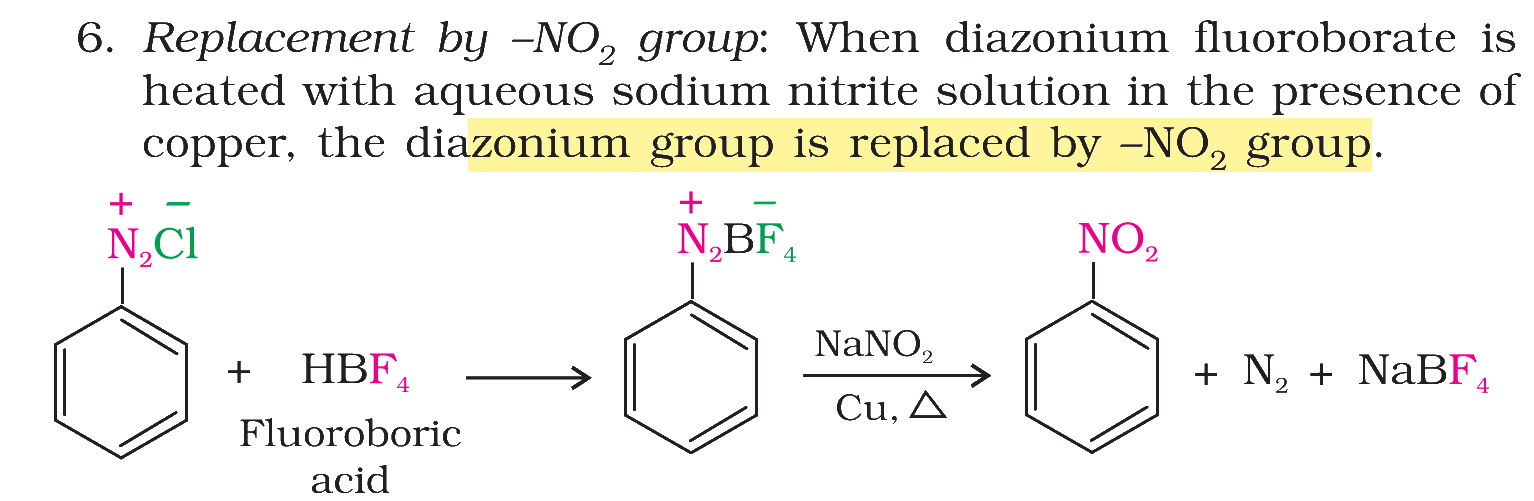
Arenediazonium salts are very useful in synthesis because the –\( \ce{N2^{+}} \) group is an excellent leaving group: it leaves as nitrogen gas and can be replaced by many other groups. Replacing it by a nitro group uses the fluoroborate salt: benzenediazonium fluoroborate is heated with aqueous sodium nitrite in the presence of copper.
The two steps of this question are:
(i) Diazonium group replaced by –NO2:
\( \displaystyle \ce{C6H5N2^+BF4^- + NaNO2} \xrightarrow[\Delta]{\ce{Cu}} \ce{C6H5NO2 + N2 + NaBF4} \)
(ii) Nitro group reduced to –NH2 by iron and concentrated hydrochloric acid:
\( \displaystyle \ce{C6H5NO2 + 3Fe + 6HCl} \xrightarrow{\Delta} \ce{C6H5NH2 + 3FeCl2 + 2H2O} \)
So the final product is aniline.
Why the other options are incorrect
Option (1) Nitrobenzene — Incorrect. This is only the product of the first step; Fe/HCl then reduces it to aniline.
Option (2) Phenol — Incorrect. Phenol forms when a diazonium salt is warmed with water, not with \( \ce{NaNO2} \)/Cu.
\( \displaystyle \ce{C6H5N2^+Cl^- + H2O} \xrightarrow{\text{warm}} \ce{C6H5OH + N2 + HCl} \)
Option (4) Chlorobenzene — Incorrect. Chlorobenzene forms from a diazonium salt with Cu2Cl2/HCl (Sandmeyer reaction); HCl here is only used with iron to reduce the nitro group.
\( \displaystyle \ce{C6H5N2^+Cl^-} \xrightarrow{\ce{Cu2Cl2}\text{/}\ce{HCl}} \ce{C6H5Cl + N2} \)
NCERT (2026-27 edition):
Replacement by –NO2 Group
Reduction of Nitro Compounds