Which of the following is NOT the problem of Indian agriculture?
Answer & explanation
Correct answer: option 4
The correct answer is Option (4) → Large size of farms
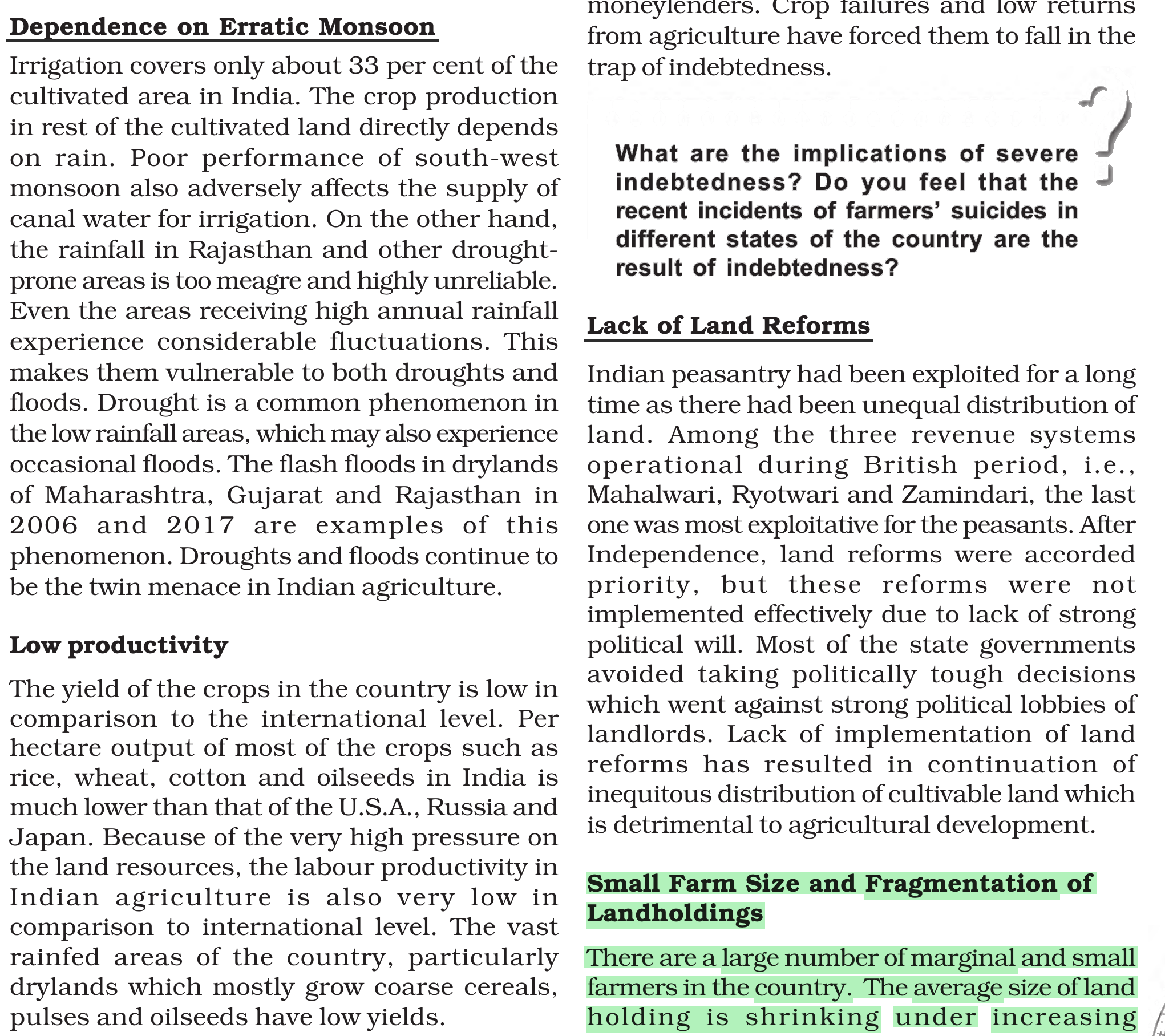
Option (1) Dependence on erratic monsoon — A problem. Irrigation covers only about 33 per cent of the cultivated area, so crops on the rest depend directly on rain. When the south-west monsoon fails or comes late, the rainfed crops dry up and even the canals run short of water; when it is too heavy, fields are flooded. The harvest rises and falls with the rain, which keeps farm output and the farmer’s income unstable.
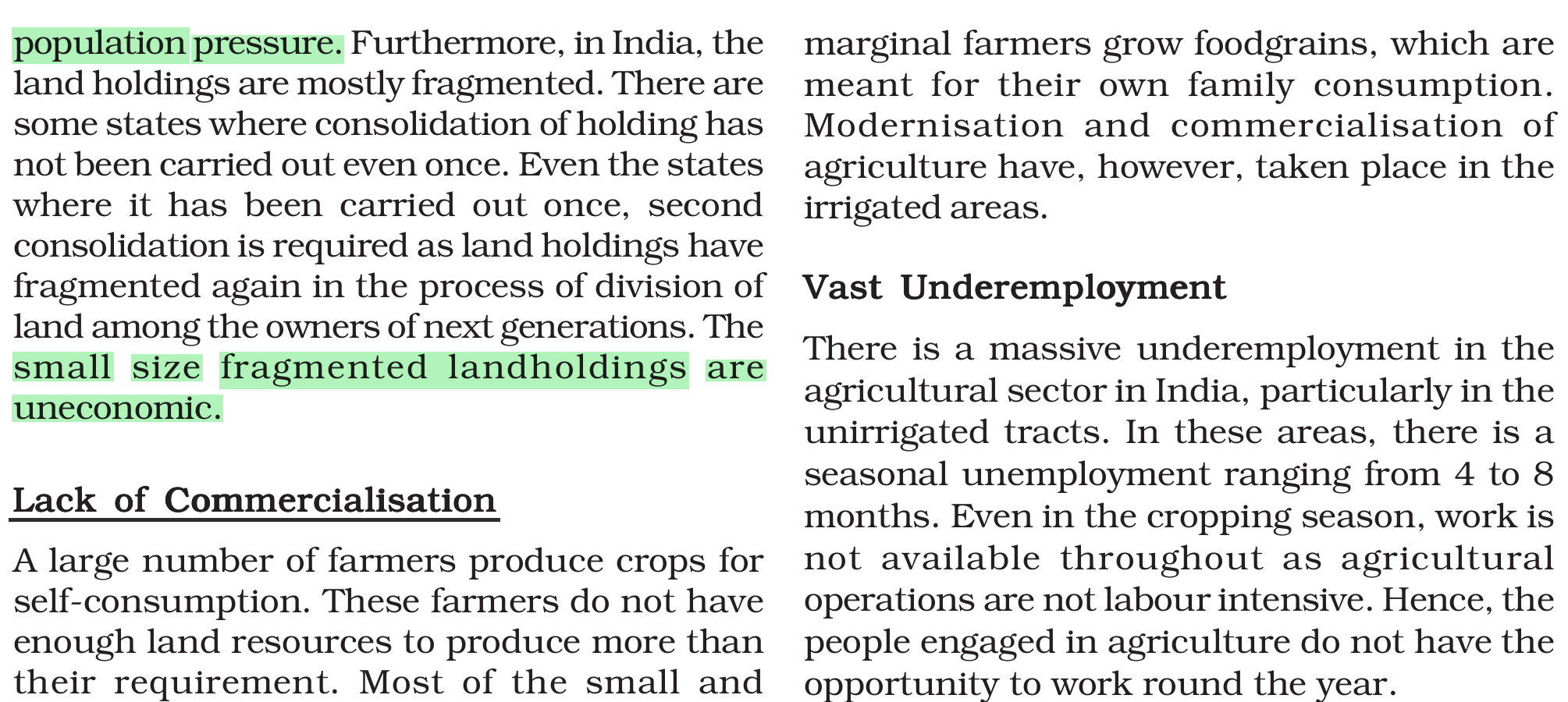
Option (2) Lack of commercialisation — A problem. A large number of farmers grow crops only for self-consumption, because their land is too small to produce more than their own needs. With little of the crop reaching the market, they earn little cash, and so cannot buy better seed, fertiliser or machines to raise their output.
Option (3) Lack of land reforms — A problem. Land was unequally distributed for a long time, and the land reforms after Independence were not implemented effectively. Much cultivable land stays with a few owners while most cultivators hold little or none, so those who work the land have neither the means nor the security to improve it.
Option (4) Large size of farms — Not a problem. The real problem is the opposite: small farm size and fragmentation of landholdings. As population grows, holdings are divided again and again, so most farmers are marginal or small and their plots lie scattered. Such small fragmented holdings are uneconomic: they yield too little to sell or to invest, whereas a larger farm would ease this. NTA changed one word, ‘small’ to ‘large’, and a real problem became the odd one out. Check the size word every time.
NCERT: India - People and Economy — Chapter 3: Land Resources and Agriculture, Problems of Indian Agriculture (both columns: the text layer runs the two columns together on these lines) (2025-26)
|