Coordination Chemistry
In the IUPAC nomenclature of coordination compounds, the groups that surround the central atom must be identified in the name. They are listed as prefixes to the name of the central atom along with any appropriate multipliers. Isomerism in Coordination Compounds are mainly of 2 types (A) Stereoisomerism viz: (i) Geometrical isomerism (ii) Optical isomerism and (B) Structural isomerism viz: (i) Linkage isomerism (ii) Coordination isomerism (iii) Ionisation isomerism (iv) Solvate isomerism. Many approaches have been put forth to explain the nature of bonding in coordination compounds viz. Valence Bond Theory (VBT), Crystal Field Theory (CFT), Ligand Field Theory (LFT) and Molecular Orbital Theory (MOT). The magnetic properties of coordination compounds can be measured by the magnetic susceptibility experiments. The results can be used to obtain information about the number of unpaired electrons and hence, structures adopted by metal complexes.
Which of the following ligands shows the highest field strength?
Answer & explanation
Correct answer: option 2
The correct answer is Option (2) → CN−
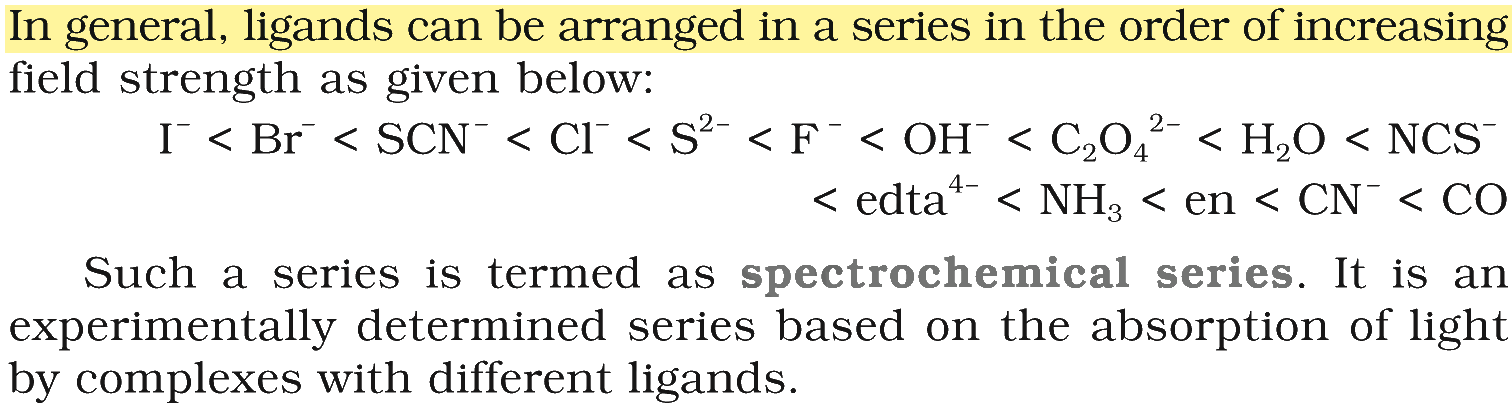
By crystal field theory, ligands split the d orbitals of the metal, and the size of the splitting (Δo) depends on the ligand. Arranged in the order of the splitting they produce, ligands form the spectrochemical series, an order found experimentally from the absorption spectra of complexes. The four given ligands sit in it as:
\( \ce{OH^{-}} \) < \( \ce{H2O} \) < \( \ce{NH3} \) < \( \ce{CN^{-}} \)
So CN− has the highest field strength. Besides donating its lone pair, \( \ce{CN^{-}} \) accepts electron density back from the metal into its empty π* orbitals, which increases the splitting further. The series does not follow the charge on the ligand: neutral \( \ce{NH3} \) and \( \ce{H2O} \) are stronger than the anion \( \ce{OH^{-}} \).
NCERT (2026-27 edition):
Crystal Field Theory – …