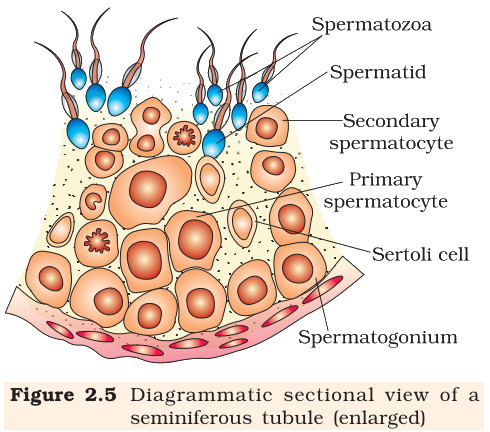
During spermatogenesis, the number of chromosomes in spermatids are:
Answer & explanation
Correct answer: option 2
The correct answer is Option (2) → 23
A human body cell is diploid: it has 46 chromosomes. In spermatogenesis, meiosis halves this number.
Primary spermatocyte (46) → meiosis I → two secondary spermatocytes (23 each)
Secondary spermatocyte (23) → meiosis II → spermatids (23 each)
Meiosis I is the reduction division. It cuts the number from 46 to 23. Meiosis II only separates the chromatids, so the number stays at 23. Each spermatid is haploid with 23 chromosomes. It then changes into a sperm by spermiogenesis, without any change in number.
NCERT Extract:
Gametogenesis – “… A primary spermatocyte completes the first meiotic division (reduction division) leading to formation of two equal, haploid cells called secondary spermatocytes, which have only 23 chromosomes each. The secondary spermatocytes undergo the second meiotic division to produce four equal, haploid spermatids (Figure 2.5).”