
Genetic disorders
Read the following passage carefully and answer the given questions.
Broadly, genetic disorders may be grouped into two categories – Mendelian disorders and Chromosomal disorders. Mendelian disorders are mainly determined by alteration or mutation in the single gene. It is important to mention here that such Mendelian disorders may be dominant or recessive. By pedigree analysis one can easily understand whether the trait in question is dominant or recessive. The chromosomal disorders on the other hand are caused due to absence or excess or abnormal arrangement of one or more chromosomes. Down’s syndrome, Turner’s syndrome, Klinefelter’s syndrome are common examples of chromosomal disorders. Mutation is defined as change in the genetic material. A point mutation is a change of a single base pair in DNA. Sickle-cell anaemia is caused due to change of one base in the gene coding for beta-chain of hemoglobin. The total number of chromosomes in a normal human cell is 46 (23 pairs). Out of these 22 pairs are autosomes and one pair of chromosomes are sex chromosome. Failure of segregation of chromatids during cell division cycle results in the gain or loss of a chromosome(s) called aneuploidy. Failure of cytokinesis after telophase stage of cell division results in an increase in a whole set of chromosomes in an organism and this phenomenon is known as polyploidy.
Identify the incorrect statement about Klinefelter’s syndrome.
Answer & explanation
Correct answer: option 2
The correct answer is Option (2) → It is caused due to the presence of an additional copy of Y chromosome.
Klinefelter’s syndrome is a chromosomal disorder of males. The person has an extra X chromosome, so the sex chromosomes are XXY and the total number is 47.
(1) It is caused due to the presence of an additional copy of X chromosome. — Correct statement. The extra chromosome is an X.
(2) It is caused due to the presence of an additional copy of Y chromosome. — Incorrect statement. The extra chromosome is not a Y. An extra Y would give XYY.
(3) The number of chromosome resulting into a karyotype of 47, XXY. — Correct statement. 44 autosomes plus XXY makes 47.
(4) Affected individual has overall masculine development. — Correct statement. The person develops as a male. Some feminine features, such as enlarged breasts (gynaecomastia), also appear, and the person is sterile.
Note: The passage is taken from NCERT. NTA has put lines of the NCERT text together to make it. Most CUET (UG) questions come straight from NCERT, so study the book line by line, including figures and their titles.
NCERT Extract:
Chromosomal Disorders –
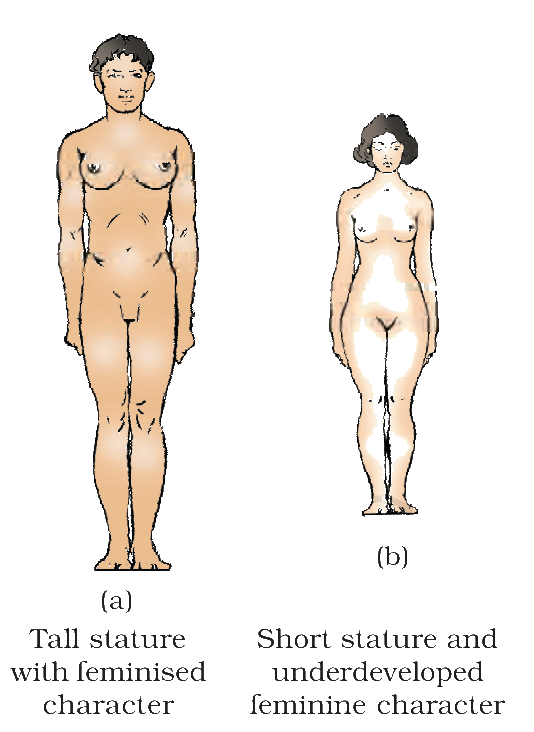
Figure 4.17 Diagrammatic representation of genetic disorders due to sex chromosome composition in humans : (a) Klinefelter Syndrome; (b) Turner’s Syndrome