What would be molar conductivity at infinite dilution Λ°m of MgSO4 if λ°m of Mg2+ is 104.0 S cm2 mol-1 and λ°m of SO42- is 166.0 S cm2 mol-1?
Answer & explanation
Correct answer: option 3
The correct answer is Option (3) → 270.0 S cm2 mol-1
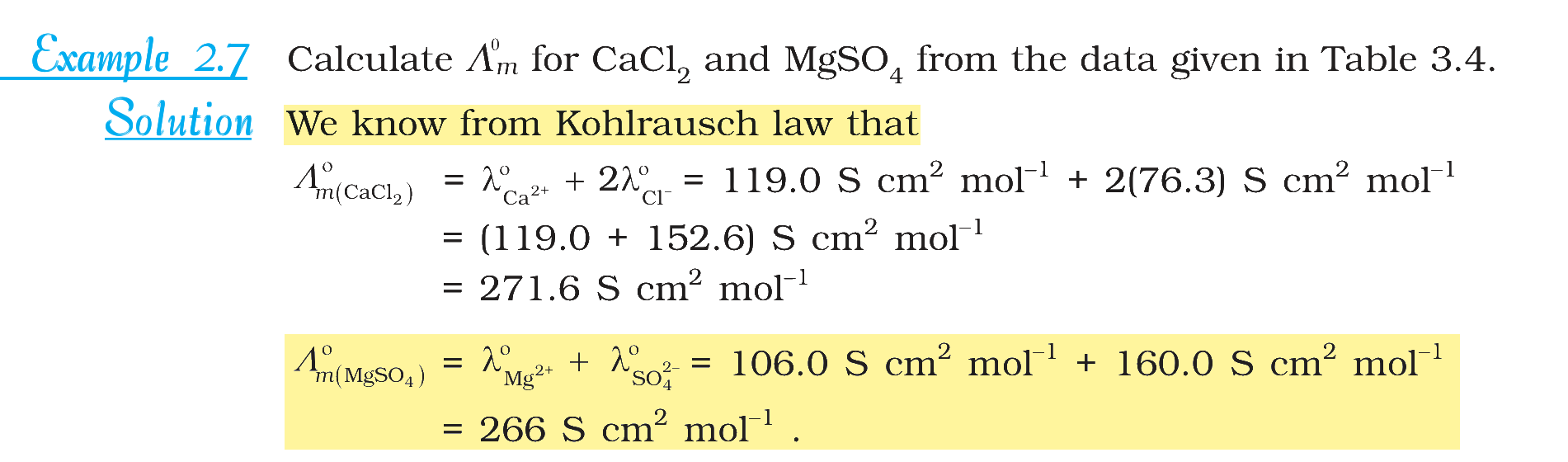
Kohlrausch’s law of independent migration of ions states that, at infinite dilution, each ion makes its own definite contribution to the molar conductivity of an electrolyte, whatever the other ion is. So the limiting molar conductivity is the sum of the ionic contributions, each multiplied by the number of that ion in the formula:
\( \displaystyle \Lambda^{\circ}_m(\mathrm{A}_x\mathrm{B}_y)=x\,\lambda^{\circ}(\mathrm{A})+y\,\lambda^{\circ}(\mathrm{B}) \)
\( \ce{MgSO4} \) gives one \( \ce{Mg^{2+}} \) ion and one \( \ce{SO4^{2-}} \) ion, so x = y = 1:
\( \displaystyle \Lambda^{\circ}_m(\mathrm{MgSO_4})=\lambda^{\circ}(\mathrm{Mg^{2+}})+\lambda^{\circ}(\mathrm{SO_4^{2-}}) \)
\( \displaystyle =104.0+166.0 \)
\( \displaystyle =270.0\ \mathrm{S\,cm^2\,mol^{-1}} \)
Note: NTA picked this question from an NCERT (2026-27) example and changed the figures. Do not ignore NCERT while practising numericals.
NCERT (2026-27 edition):
Variation of Conductivity and Molar Conductivity with Concentration – …