
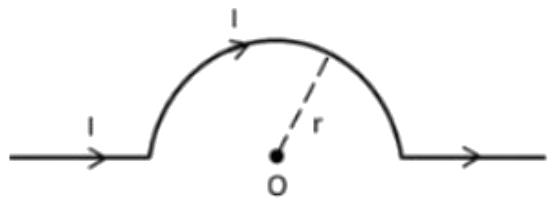
A long wire is given a semi circular bend as shown in the figure. The magnetic induction at the point \( O \), when current \( I \) is flowing through the wire is
Answer & explanation
Correct answer: option 2
The correct answer is Option (2) → \( \displaystyle\frac{\mu_0 I}{4r} \)
Use the Biot–Savart law for each part of the wire. The two straight parts lie on the line through O, so for each of their elements \( d\vec{l} \) is parallel to \( \vec{r} \) and \( d\vec{l}\times\vec{r} = 0 \): they give no field at O.
The semicircle of radius r gives half the field of a complete circular loop at its centre.
\( \displaystyle B = \frac{1}{2} \times \frac{\mu_0I}{2r} = \frac{\mu_0I}{4r} \)
Note: NTA picked this question from an NCERT (2026-27) example and changed the figures. Do not ignore NCERT while practising numericals.
NCERT (2026-27):
Magnetic Field on the Axis of a Circular Current Loop – “… (a) \( d\mathbf{l} \) and \( \mathbf{r} \) for each element of the straight segments are parallel. Therefore, \( d\mathbf{l} \times \mathbf{r} = 0 \). Straight segments do not contribute to \( |\mathbf{B}| \).
(b) For all segments of the semicircular arc, \( d\mathbf{l} \times \mathbf{r} \) are all parallel to each other (into the plane of the paper). All such contributions add up in magnitude. Hence direction of B for a semicircular arc is given by the right-hand rule and magnitude is half that of a circular loop.”