CUETMOCK
  • Pricing
  • Mentors
Log inStart freeStart free mocks→

First test, then trust

Try a free CUET mock test.

Join 5,00,000+ students who rehearsed exam day on the exact NTA screen before sitting CUET. On the web and on Android.

Start free mocks →Get the Android app
CUETMOCK

India's #1 CUET Mock Test Platform. Original NCERT-based questions on the exact NTA exam screen — trusted by 5,00,000+ students since CUET 2022.

Get it onGoogle PlayScan to download the CUETMOCK app

Mock tests

  • CUET mock test series
  • Commerce mocks
  • Humanities (Arts) mocks
  • Science mocks
  • Languages & GAT mocks
  • Free practice questions
  • Pricing

Resources

  • CUET exam guide
  • CUET syllabus
  • Universities accepting CUET
  • Expert blogs
  • News & notifications
  • Webinars & counselling
  • CUET score calculator
  • How we estimate your rank
  • FAQs

Company

  • About us
  • Our leadership & team
  • Our toppers
  • Mentors
  • For schools
  • Contact us
  • Terms
  • Privacy
  • Refund policy

Talk to us

+91 7696 6630 56info@cuetmock.comWhatsApp us

Our other platforms

  • JEE Mock — For IIT-JEE aspirants
  • NEET Mock — For NEET aspirants

Newsletter

Exam updates, study material and offers — no spam.

© 2026 NYC Ventures Pvt. Ltd.

701-702, Royal Business Park, Zirakpur, Punjab - 140603

  • Terms of use
  • Privacy policy
  • Refund policy
  • Contact us

iCUETMOCK is an independent preparation platform, not affiliated with the National Testing Agency (NTA). Always check exam details on the official NTA website.

  • Home
  • Mock tests
  • CUET guide
  • Pricing
  • Log in
Home/Practice questions/Biology
BiologyPrinciples of Inheritance and Variation

The symptoms of short stature with small round head, furrowed tongue…

Genetic disorders

Read the following passage carefully and answer the given questions.

Broadly, genetic disorders may be grouped into two categories – Mendelian disorders and Chromosomal disorders. Mendelian disorders are mainly determined by alteration or mutation in the single gene. It is important to mention here that such Mendelian disorders may be dominant or recessive. By pedigree analysis one can easily understand whether the trait in question is dominant or recessive. The chromosomal disorders on the other hand are caused due to absence or excess or abnormal arrangement of one or more chromosomes. Down’s syndrome, Turner’s syndrome, Klinefelter’s syndrome are common examples of chromosomal disorders. Mutation is defined as change in the genetic material. A point mutation is a change of a single base pair in DNA. Sickle-cell anaemia is caused due to change of one base in the gene coding for beta-chain of hemoglobin. The total number of chromosomes in a normal human cell is 46 (23 pairs). Out of these 22 pairs are autosomes and one pair of chromosomes are sex chromosome. Failure of segregation of chromatids during cell division cycle results in the gain or loss of a chromosome(s) called aneuploidy. Failure of cytokinesis after telophase stage of cell division results in an increase in a whole set of chromosomes in an organism and this phenomenon is known as polyploidy.

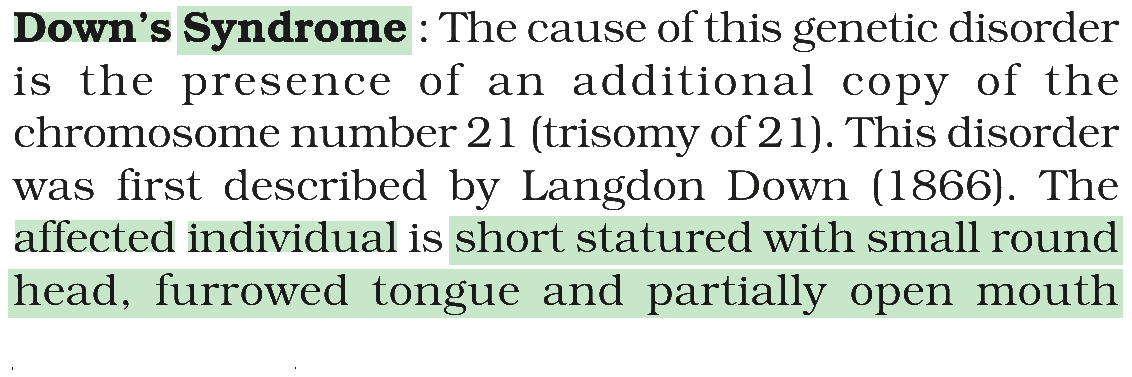
The symptoms of short stature with small round head, furrowed tongue and partially open mouth in affected individual are found in:

Answer & explanation+

Correct answer: option 2

The correct answer is Option (2) → Down’s syndrome

Down’s syndrome is caused by an extra copy of chromosome 21 (trisomy 21), so the person has 47 chromosomes. The affected person is short, with a small round head, a furrowed tongue and a partially open mouth. Physical, psychomotor and mental development is slow.

(1) Klinefelter’s Syndrome — Incorrect. The karyotype is 47, XXY. The person is tall, with some feminised features, and is sterile.

(2) Down’s syndrome — Correct. These are its typical features.

(3) Turner’s Syndrome — Incorrect. One X chromosome is missing (45, XO). The female is short, with rudimentary ovaries and poorly developed secondary sexual characters.

(4) Myotonic dystrophy — Incorrect. It is a single-gene disorder that is inherited as an autosomal dominant trait. It is not a chromosomal disorder with these features.

Note: The passage is taken from NCERT. NTA has put lines of the NCERT text together to make it. Most CUET (UG) questions come straight from NCERT, so study the book line by line, including figures and their titles.

NCERT Extract:
Chromosomal Disorders –
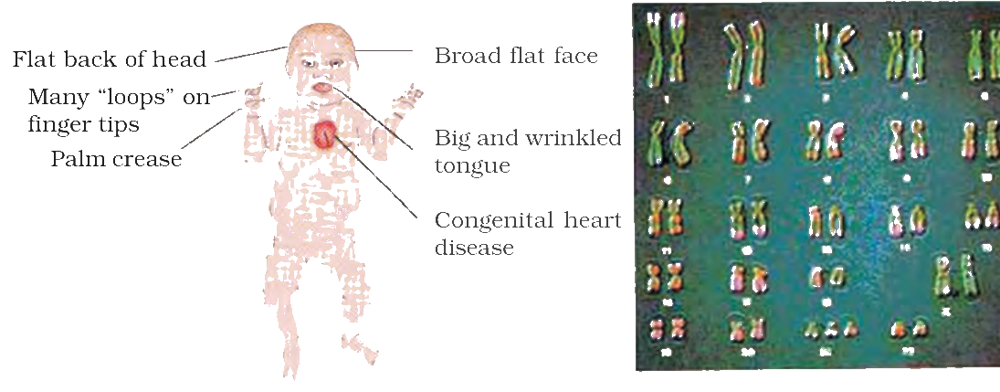
Textbook extract

Textbook figure

Figure 4.16 A representative figure showing an individual inflicted with Down’s syndrome and the corresponding chromosomes of the individual

Advertisement

Practise more on Principles of Inheritance and Variation

Chapter-wise mocks on the real NTA exam screen, with solutions and your rank. Your first mocks are free.

Start free mocks →

Advertisement

Next questions

  1. A coin is tossed four times. The probability of getting at least 1 head before getting the first tail isMaths. Section B1 · Probability
  2. Arrange the following events in Indian politics in the correct chronological order.A. The Sikkim Assembly passed a resolution asking for fu…Political Science · Politics in India Since Independence: Regional Aspirations
  3. Lockers Rent Received during the year by a club is Rs. 17,050. Locker rent Rs. 3,050 outstanding for the previous year and Rs. 1500 outstan…Accountancy Part A · Accounts for Non Profit Organsiation
  4. The amount of premium for goodwill brought in by the new partner is shared by the existing partners in their:Accountancy Part A · Admission of a Partner
  5. For an element, mass of nucleus is 7.05 u, the mass of protons is 3.023475 u and the mass of neutrons is 4.034660 u. If 1 u = 931.5 MeV/c2,…Physics · Nuclei
  6. The value of 'Z' in the equation, log S = log C + Z log A, ranges from:Biology · Biodiversity and Conservation
  7. If A= […] and |A^3|=125 , then the value of k isApplied Maths. Section A · Determinants (Section A)
  8. ∫_1^2displaystyledx/((x+1)(x+2))=Applied Maths. Section A · Definite Integration (Section A)
  9. In reference to the Inferential Statistics, which of the following statements are correct?A. The number of degrees of freedom of a statisti…Applied Maths. Section B2 · Inferential Statistics
  10. Match List-I with List-IIList-IList-II(A)The range of sin^-1x (I) [-1,1] (B)Domain of cos^-1x (II) (-∞,∞) (C)The range of tan^-1x (III) ≤ft…Maths. Section B1 · Inverse Trigonometric Functions