LEGO case
In the year when LEGO was launched, they became popular because of the modern kind of quality toys they were producing. Their products were designed in the beginning for young boys who have a tendency to get bored easily and wanted to play with innovative toys. They designed building blocks which could be joined together to form more than hundred combinations. This kept the young consumers engaged for long time. They advertised in the television ads and in the newspapers. Later, they encountered a backlash from the activist groups that LEGO was not inclusive and had been advertising their products using stereotypes like only boys play with building blocks or only boys are creators while showing girls playing with dolls in their ads. This led to slump in the demand for LEGO products and they faced another problem, their stocks went unsold while they kept on producing more and more thinking that if the LEGO products are of good quality and design with new features, they will be sold automatically. To induce demand, they kept on giving 10% discounts to those who buy two products.
A new marketing manager was hired, and she stopped the production until a new advertising campaign was released. She hired a public relations agent to manage the negative sentiment in the market. A new line of Lego games were released with both male and female characters. The new ad campaign focused on showing both young boys and girls playing as well as adults involved in the fun activities. LEGO brings to the table for all. A lucky draw was introduced for the first hundred buyers. LEGO achieved 20% sales growth in a month and they were successful in fostering their belief in creative and innovative futuristic games for all.
The strategy of “10% discounting” is related to which “P” of marketing mix?
Answer & explanation
Correct answer: option 4
The correct answer is Option (4) → Promotion
Option (1) Product — Incorrect. Product decisions are about what is sold: its design, features, quality and brand. A discount does not change the toy.
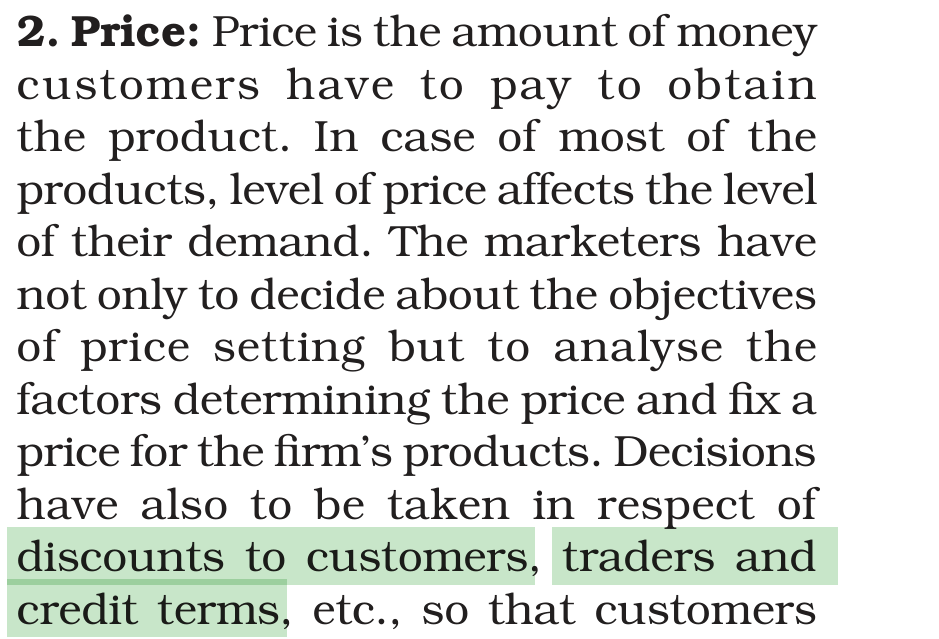
Option (2) Price — Incorrect. The price element fixes the regular price of the product and the terms that go with it. LEGO’s price policy did not change. The discount was a short offer made to push sales (see the Note).
Option (3) Place — Incorrect. Place is about getting the product to the buyer: channels, stores, stock and transport.
Option (4) Promotion — Correct. Sales promotion means short-term incentives that push people to buy now. Discount (“offering products at less than list price”) is one of the sales promotion activities, next to rebates, quantity gifts and lucky draws. The passage says LEGO gave the discount “to induce demand”, so it is a sales promotion tool, and sales promotion is part of the promotion mix.
Note: NCERT speaks of discounts in two places, and this is why Price can look right. Under the price element, it says decisions have to be taken “in respect of discounts to customers, traders and credit terms”. These discounts are part of the regular price policy: the terms on which the product is always sold. Under sales promotion, NCERT calls sales promotion “short-term incentives, which are designed to encourage the buyers to make immediate purchase”, and lists Discount (“Offering products at less than list price”) as one of its activities, with a shoe company’s “Discount Up to 50%” offer as the example. LEGO’s discount is of the second kind. It came when sales had slumped, it was given “to induce demand”, and it applied only to those who bought two products. It was a short push to make people buy now, not a new price policy. That makes it sales promotion, which is part of Promotion.
NCERT (2026-27 Edition): “Sales promotion refers to short-term incentives, which are designed to encourage the buyers to make immediate purchase of a product or service. These include all promotional efforts other than advertising, personal selling and publicity, used by a company to boost its sales. Sales promotion activities include offering cash discounts, sales contests, free gift offers, and free sample distribution. …” “2. Discount: Offering products at less than list price. …”
|