
Identify the most appropriate alkene for synthesis of the following alcohol.
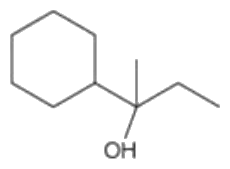
Answer & explanation
Correct answer: option 2
The correct answer is Option (2) → 2-cyclohexylbut-1-ene
Alcohols are made from alkenes by acid-catalysed hydration, which follows Markovnikov’s rule. The \( \ce{H^{+}} \) adds to the double-bond carbon that already carries more hydrogen atoms. This forms the more stable carbocation, and water then attacks that carbocation. So the –OH ends up on the more substituted carbon of the double bond.
A carbocation can also rearrange by a hydride shift to a more stable one, which gives a mixture. The most appropriate alkene is therefore the one that forms the required carbocation directly, with no rearrangement.
The target alcohol is 2-cyclohexylbutan-2-ol: its C-2 carries the –OH, a \( \ce{CH3} \) group, a \( \ce{C2H5} \) group and the cyclohexyl ring. In 2-cyclohexylbut-1-ene, \( \ce{H^{+}} \) adds to the terminal =\( \ce{CH2} \). This gives the tertiary carbocation \( \ce{CH3-C^{+}(C6H11)-CH2CH3} \) directly, and water attacks it:
\( \displaystyle \ce{CH2=C(C6H11)-CH2CH3 + H2O} \xrightarrow{\ce{H^{+}}} \ce{CH3-C(OH)(C6H11)-CH2CH3} \)
So the most appropriate alkene is 2-cyclohexylbut-1-ene.
Why the other options are incorrect
Option (1) 3-(butan-2-yl)cyclohex-1-ene — Incorrect. The double bond is inside the ring, so hydration puts the –OH on a ring carbon, not on the side-chain carbon.
Option (3) 1-(butan-2-yl)cyclohex-1-ene — Incorrect. Protonation gives a tertiary carbocation on the ring carbon, so the product is 1-(butan-2-yl)cyclohexan-1-ol, with the –OH on the ring.
Option (4) 3-cyclohexylbut-1-ene — Incorrect. Markovnikov addition first gives a secondary carbocation on C-2, which leads to 3-cyclohexylbutan-2-ol. The target forms only after a hydride shift, so a mixture results.
NCERT (2026-27 edition):
From Alkenes
