The best reagent for converting 2-phenylpropanamide into 1-phenylethanamine is
Answer & explanation
Correct answer: option 2
The correct answer is Option (2) → Br2 in aqueous NaOH.
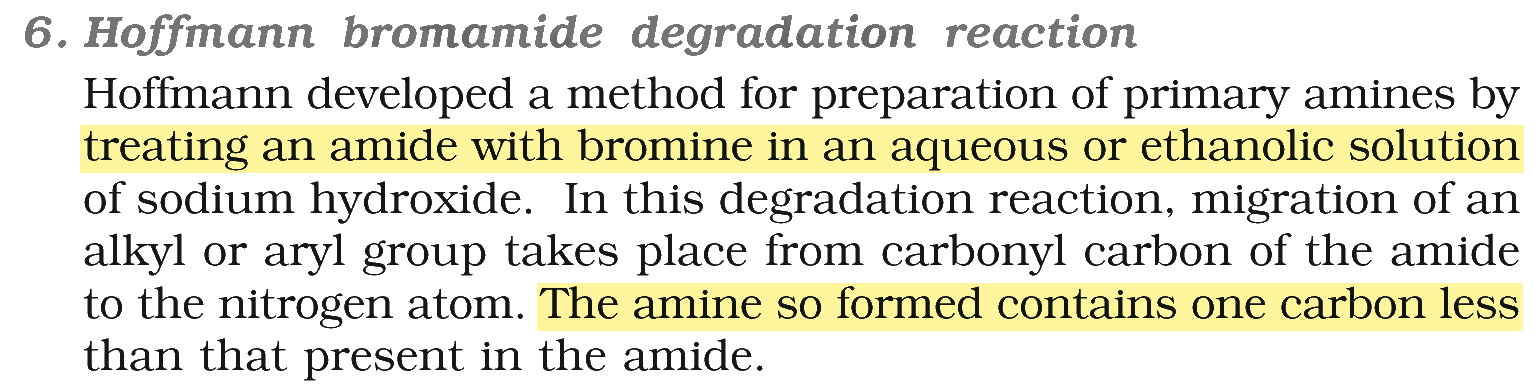
The Hofmann bromamide degradation converts an amide into a primary amine with one carbon atom fewer. The amide is heated with bromine in aqueous (or ethanolic) sodium hydroxide; the carbonyl carbon is lost as carbonate, and the alkyl or aryl group moves from the carbonyl carbon to the nitrogen:
\( \displaystyle \ce{R-CONH2 + Br2 + 4NaOH -> R-NH2 + Na2CO3 + 2NaBr + 2H2O} \)
2-Phenylpropanamide has 9 carbon atoms and 1-phenylethanamine has 8. The group R, \( \ce{CH3CH(C6H5)} \)–, stays the same; only the –\( \ce{CONH2} \) group becomes –\( \ce{NH2} \):
\( \displaystyle \ce{CH3-CH(C6H5)-CONH2 + Br2 + 4NaOH -> CH3-CH(C6H5)-NH2 + Na2CO3 + 2NaBr + 2H2O} \)
So the best reagent is Br2 in aqueous NaOH.
Why the other options are incorrect
Option (1) excess H2 — Incorrect. A reduction never removes a carbon atom, so the product would keep all nine carbons and could not be 1-phenylethanamine.
Option (3) Iodine in the presence of red phosphorus — Incorrect. This reagent (which forms \( \ce{PI3} \)) converts alcohols into iodoalkanes; it does not turn an amide into an amine.
Option (4) LiAlH4 in ether — Incorrect. \( \ce{LiAlH4} \) reduces the amide C=O group to \( \ce{CH2} \) and keeps all the carbon atoms. It would give 2-phenylpropan-1-amine, not 1-phenylethanamine:
\( \displaystyle \ce{CH3-CH(C6H5)-CONH2} \xrightarrow[\text{(ii) }\ce{H2O}]{\text{(i) }\ce{LiAlH4}\text{, ether}} \ce{CH3-CH(C6H5)-CH2NH2} \)
NCERT (2026-27 edition):
Hoffmann Bromamide Degradation Reaction