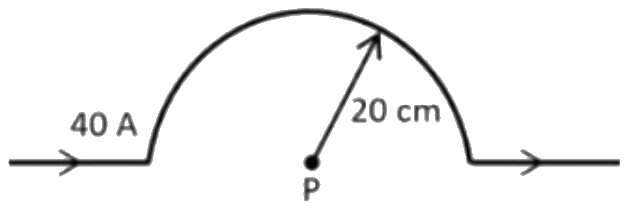
A straight wire carrying a current of \( 40\,\mathrm{A} \) is bent into a semicircular arc of radius \( 20\,\mathrm{cm} \) as shown in figure below. The magnetic field produced at the center (P) of arc is:
Answer & explanation
Correct answer: option 4
The correct answer is Option (4) → \( 2\pi\times10^{-5}\,\mathrm{T} \)
Only the semicircular arc produces a field at P. The straight parts of the wire lie on the line passing through P, so for every element of them \( d\vec{l} \) is parallel to \( \vec{r} \) and, by the Biot-Savart law, \( d\vec{l}\times\vec{r} = 0 \).
A full circular loop gives \( \mu_0I/2r \) at its centre; a semicircle gives half of that.
\( I = 40\,\mathrm{A} \)
\( r = 20\,\mathrm{cm} = 0.2\,\mathrm{m} \)
\( \displaystyle B = \frac{1}{2}\times\frac{\mu_0I}{2r} = \frac{\mu_0I}{4r} = \frac{4\pi\times10^{-7}\times40}{4\times0.2} \)
\( \displaystyle B = \frac{160\pi\times10^{-7}}{0.8} = 200\pi\times10^{-7} = 2\pi\times10^{-5}\,\mathrm{T} \)
Note: NTA picked this question from an NCERT (2026-27) example and changed the figures. Do not ignore NCERT while practising numericals.
NCERT (2026-27):
Magnetic Field on the Axis of a Circular Current Loop – …