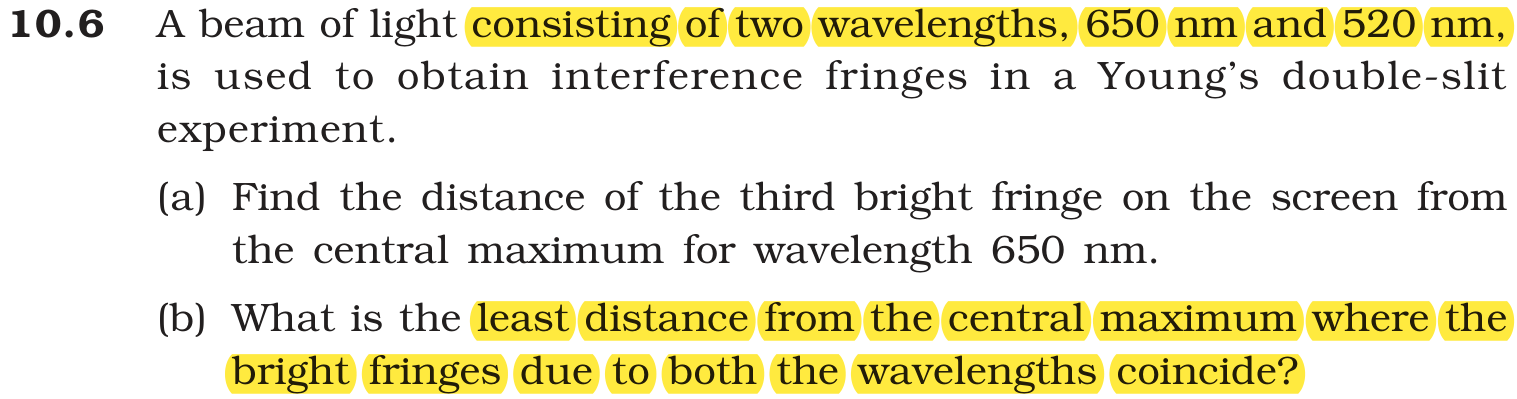
A beam of light consisting of two wavelengths, 800 nm and 600 nm is used in Young's double-slit experiment to obtain interference fringes. The slit separation is 0.5 mm and the screen is kept 100 cm away from the plane of the slits. The least distance from the central maximum where the bright fringes due to both the wavelengths coincide is
Answer & explanation
Correct answer: option 3
The correct answer is Option (3) → 4.8 mm
The bright fringes of the two wavelengths coincide where the path difference is a whole number of wavelengths for both at the same point:
\( \displaystyle y = \frac{n_1\lambda_1 D}{d} = \frac{n_2\lambda_2 D}{d} \Rightarrow n_1\lambda_1 = n_2\lambda_2 \)
\( \displaystyle n_1 \times 800\,\mathrm{nm} = n_2 \times 600\,\mathrm{nm} \Rightarrow \frac{n_1}{n_2} = \frac{3}{4} \)
The smallest whole numbers are \( n_1 = 3 \) and \( n_2 = 4 \), giving a common path difference of 2400 nm.
\( \displaystyle y = \frac{3 \times 800\times10^{-9}\,\mathrm{m} \times 1\,\mathrm{m}}{0.5\times10^{-3}\,\mathrm{m}} \)
\( \displaystyle y = 4.8\times10^{-3}\,\mathrm{m} = 4.8\,\mathrm{mm} \)
Shortcut: The fringe widths are 1.6 mm (800 nm) and 1.2 mm (600 nm). The least distance at which both fit a whole number of times is their LCM, 4.8 mm.
Note: NTA picked this question from an NCERT (2026-27) exercise and changed the figures. Do not ignore NCERT while practising numericals.
NCERT (2026-27):
Exercises – …