
CUETMOCK
  • Pricing
  • Mentors
Log inStart freeStart free mocks→

First test, then trust

Try a free CUET mock test.

Join 5,00,000+ students who rehearsed exam day on the exact NTA screen before sitting CUET. On the web and on Android.

Start free mocks →Get the Android app
CUETMOCK

India's #1 CUET Mock Test Platform. Original NCERT-based questions on the exact NTA exam screen — trusted by 5,00,000+ students since CUET 2022.

Get it onGoogle PlayScan to download the CUETMOCK app

Mock tests

  • CUET mock test series
  • Commerce mocks
  • Humanities (Arts) mocks
  • Science mocks
  • Languages & GAT mocks
  • Free practice questions
  • Pricing

Resources

  • CUET exam guide
  • CUET syllabus
  • Universities accepting CUET
  • Expert blogs
  • News & notifications
  • Webinars & counselling
  • CUET score calculator
  • How we estimate your rank
  • FAQs

Company

  • About us
  • Our leadership & team
  • Our toppers
  • Mentors
  • For schools
  • Contact us
  • Terms
  • Privacy
  • Refund policy

Talk to us

+91 7696 6630 56info@cuetmock.comWhatsApp us

Our other platforms

  • JEE Mock — For IIT-JEE aspirants
  • NEET Mock — For NEET aspirants

Newsletter

Exam updates, study material and offers — no spam.

© 2026 NYC Ventures Pvt. Ltd.

701-702, Royal Business Park, Zirakpur, Punjab - 140603

  • Terms of use
  • Privacy policy
  • Refund policy
  • Contact us

iCUETMOCK is an independent preparation platform, not affiliated with the National Testing Agency (NTA). Always check exam details on the official NTA website.

  • Home
  • Mock tests
  • CUET guide
  • Pricing
  • Log in
Home/Practice questions/Chemistry
ChemistryInorganic: Coordination Compounds

In metal carbonyls, M-C pi bond is formed by :

In metal carbonyls, M-C pi bond is formed by :

Answer & explanation+

Correct answer: option 1

The correct answer is Option (1) → Donation of a pair of electrons from a filled d-orbital of metal into the vacant anti-bonding orbital of carbon monoxide.

The π part of the M–C bond is formed by back bonding from the metal to CO. Since the back-donated electrons enter an antibonding orbital of CO, the C–O bond becomes slightly weaker.

So the M–C π bond is formed by donation from a filled metal d orbital into the vacant antibonding orbital of CO.

Why the other options are incorrect

  • Option (2) Donation of a pair of electrons from a filled d-orbital of metal into the vacant bonding orbital of carbon monoxide — Incorrect. The bonding orbitals of CO are already filled, so they cannot accept electrons. Only the antibonding π* orbitals are vacant.

  • Option (3) Donation of a pair of electrons from a filled p-orbital of metal into the vacant anti-bonding orbital of carbon monoxide — Incorrect. Back bonding uses the filled (n−1)d orbitals of the transition metal, not p orbitals.

  • Option (4) Donation of a pair of electrons from anti-bonding orbital of carbon monoxide into the vacant d-orbital of metal — Incorrect. The antibonding orbital of CO is empty, so it has no electrons to donate. Donation from CO to the metal comes from the carbon lone pair and forms the σ bond.

NCERT (2026-27 edition):
Bonding in Metal Carbonyls – …
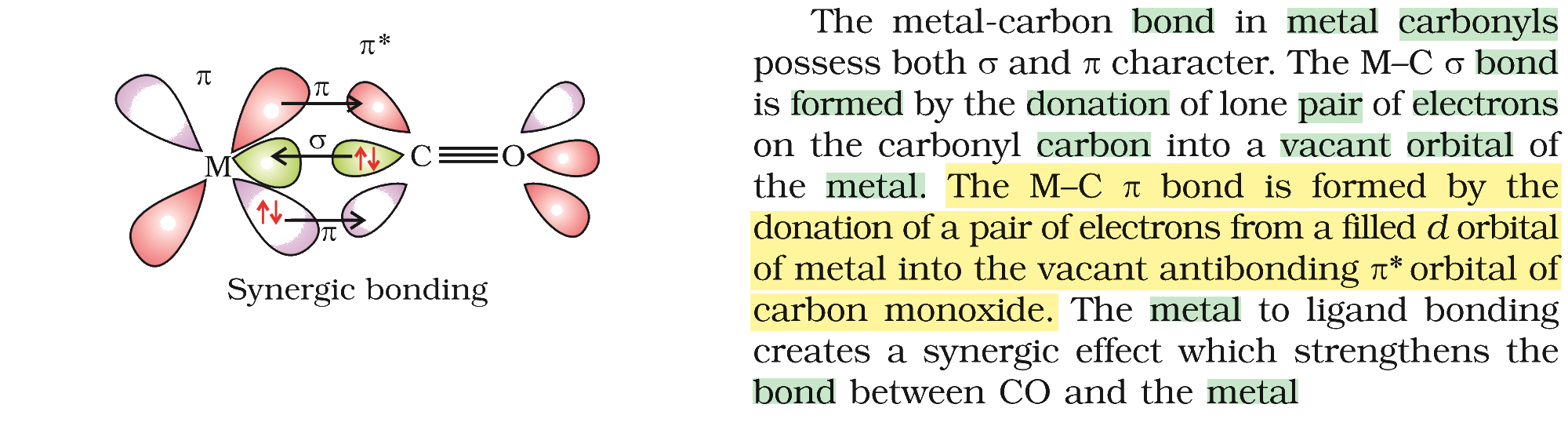
Textbook extract

Advertisement

Practise more on Inorganic: Coordination Compounds

Chapter-wise mocks on the real NTA exam screen, with solutions and your rank. Your first mocks are free.

Start free mocks →

Advertisement

Next questions

  1. Arrange the following transitions labelled as A, B, C and D, respectively (shown in the energy level diagram below) according to wavelength…Physics · Atoms
  2. Identify the correct statements regarding water resources of India.(A) India accounts for about 4 percent of the world’s water resources.(B…Geography · India-People and Economy: Water resources
  3. In an ac circuit, the current is referred to as wattless current, when:Physics · Alternating Current
  4. If […] =0 , then the value of x+y+z isMaths. Section B1 · Determinants
  5. Which of the following is not an importance of Decentralisation?Business Studies · Organising
  6. Match List-I with List-II:List-ILeaders of 1857List-IIAssociations(A)Kunwar Singh(I)Son of the Nawab of Awadh(B)Nana Sahib(II)A local zamin…History · Modern India: Rebels and the Raj
  7. Identify the correct sequence which are involved in DNA fingerprinting.A. Separation of DNA by electrophoresisB. Isolation of DNAC. Transfe…Biology · Molecular Basis of Inheritance
  8. Match Idioms given in List-I with their correct meanings given in List-IILIST-I(Idioms)LIST-II(Meanings)A. Above boardI. Not deservingB. A…English · Grammar: Idioms
  9. Choose the correct statement from the following regarding the Partner's Capital.Accountancy Part A · Accounting for Partnership
  10. Solution of the differential equation xlog_ex dy=y dx is: ( where c is an arbitrary constant)Maths. Section A · Differential Equations