
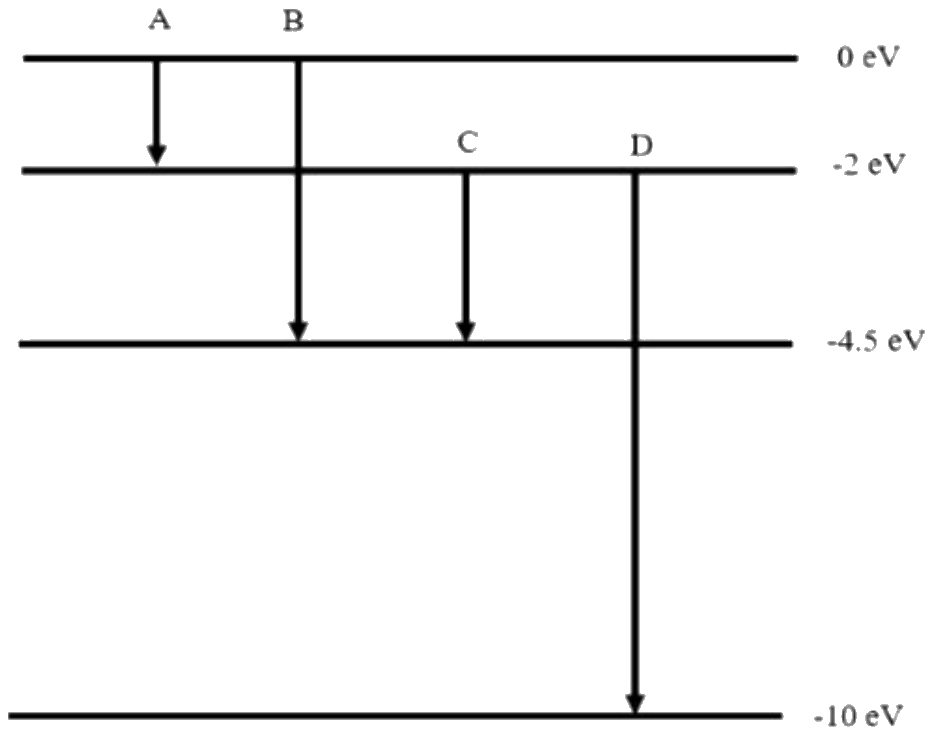
Arrange the following transitions labelled as A, B, C and D, respectively (shown in the energy level diagram below) according to wavelengths of emitted photons in increasing order.
(A) \( 0\ \mathrm{eV} \) to \( -2\ \mathrm{eV} \)
(B) \( 0\ \mathrm{eV} \) to \( -4.5\ \mathrm{eV} \)
(C) \( -2\ \mathrm{eV} \) to \( -4.5\ \mathrm{eV} \)
(D) \( -2\ \mathrm{eV} \) to \( -10\ \mathrm{eV} \)
Choose the correct answer from the options given below:
Answer & explanation
Correct answer: option 2
The correct answer is Option (2) → (D), (B), (C), (A)
The energy of the emitted photon equals the difference between the two energy levels, and its wavelength is inversely proportional to that energy: \( \lambda = hc/\Delta E \). So increasing wavelength means decreasing energy difference.
Energy differences read from the diagram:
\( \Delta E_{A} = 0 - (-2) = 2\ \mathrm{eV} \)
\( \Delta E_{B} = 0 - (-4.5) = 4.5\ \mathrm{eV} \)
\( \Delta E_{C} = -2 - (-4.5) = 2.5\ \mathrm{eV} \)
\( \Delta E_{D} = -2 - (-10) = 8\ \mathrm{eV} \)
In decreasing order of energy: \( 8 \gt 4.5 \gt 2.5 \gt 2 \) eV, which is D, B, C, A.
So in increasing order of wavelength: (D), (B), (C), (A).