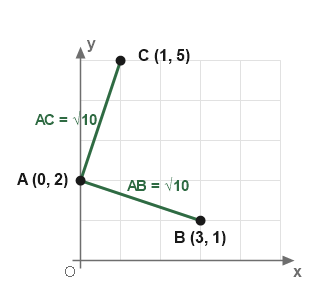
If the point \(A(0,2)\) is equidistant from the points \(B(3,p)\) and \(C(p,5)\), the value of \(p\) is:
Answer & explanation
Correct answer: option 1
The correct answer is Option (1) → 1
A is equidistant from B and C when \(AB=AC\). Working with the squares of the distances, given by the distance formula \(d^{2}=(x_2-x_1)^{2}+(y_2-y_1)^{2}\), avoids square roots; equal distances have equal squares.
Square of the distance from A to B: \(AB^{2}=(3-0)^{2}+(p-2)^{2}=9+(p-2)^{2}\)
Square of the distance from A to C: \(AC^{2}=(p-0)^{2}+(5-2)^{2}=p^{2}+9\)
Equating them, the 9 cancels: \((p-2)^{2}=p^{2}\), so \(p^{2}-4p+4=p^{2}\)
The \(p^{2}\) terms cancel too: \(-4p+4=0\), so \(p=\) 1