Gabriel phthalimide synthesis of amines produces
Answer & explanation
Correct answer: option 3
The correct answer is Option (3) → primary amines.
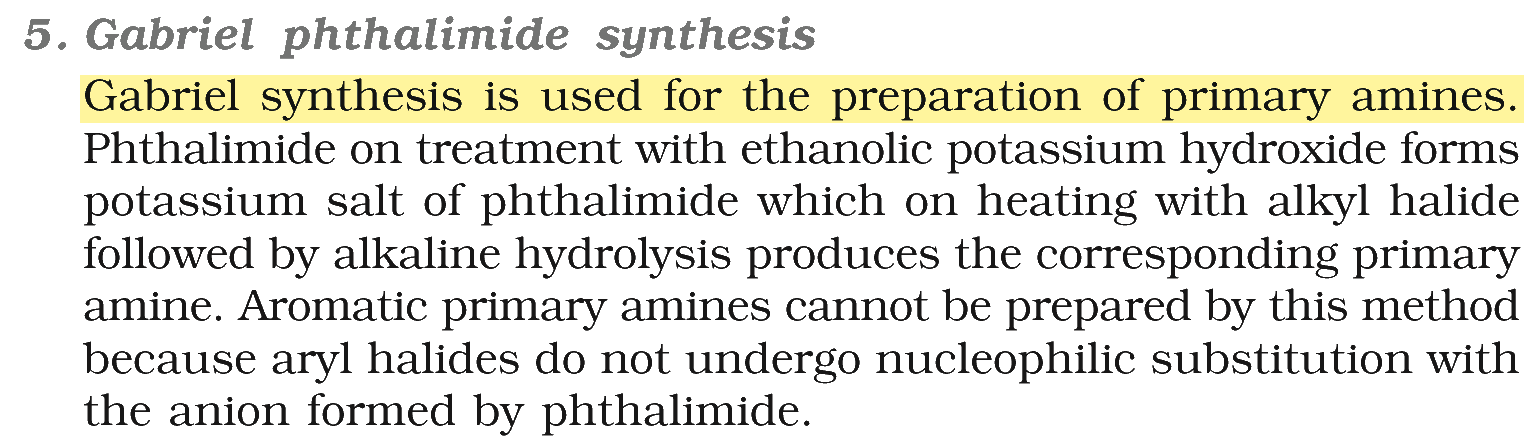
In the Gabriel phthalimide synthesis, phthalimide is treated with ethanolic KOH to form potassium phthalimide. Its nitrogen anion displaces the halogen of an alkyl halide to give an N-alkylphthalimide, which on alkaline hydrolysis releases the amine:
\( \displaystyle \ce{C6H4(CO)2NH} \xrightarrow{\text{ethanolic KOH}} \ce{C6H4(CO)2N^-K^+} \)
\( \displaystyle \ce{C6H4(CO)2N^-K^+ + R-X -> C6H4(CO)2N-R + KX} \)
\( \displaystyle \ce{C6H4(CO)2N-R} \xrightarrow{\ce{NaOH(aq)}} \ce{R-NH2 + C6H4(COONa)2} \)
Phthalimide has only one N–H hydrogen, so only one alkyl group can be attached to nitrogen. After hydrolysis, the nitrogen carries one alkyl group and two hydrogens.
So the Gabriel synthesis gives pure primary amines, free from secondary and tertiary amines.
Why the other options are incorrect
Option (1) tertiary amines — Incorrect. A tertiary amine needs three alkyl groups on nitrogen, but the phthalimide nitrogen can take only one.
Option (2) secondary amines — Incorrect. For the same reason a second alkyl group cannot be introduced.
Option (4) aromatic secondary amines — Incorrect. Aryl halides do not undergo nucleophilic substitution with the phthalimide anion, so even aromatic primary amines cannot be made this way.
NCERT (2026-27 edition):
Gabriel Phthalimide Synthesis