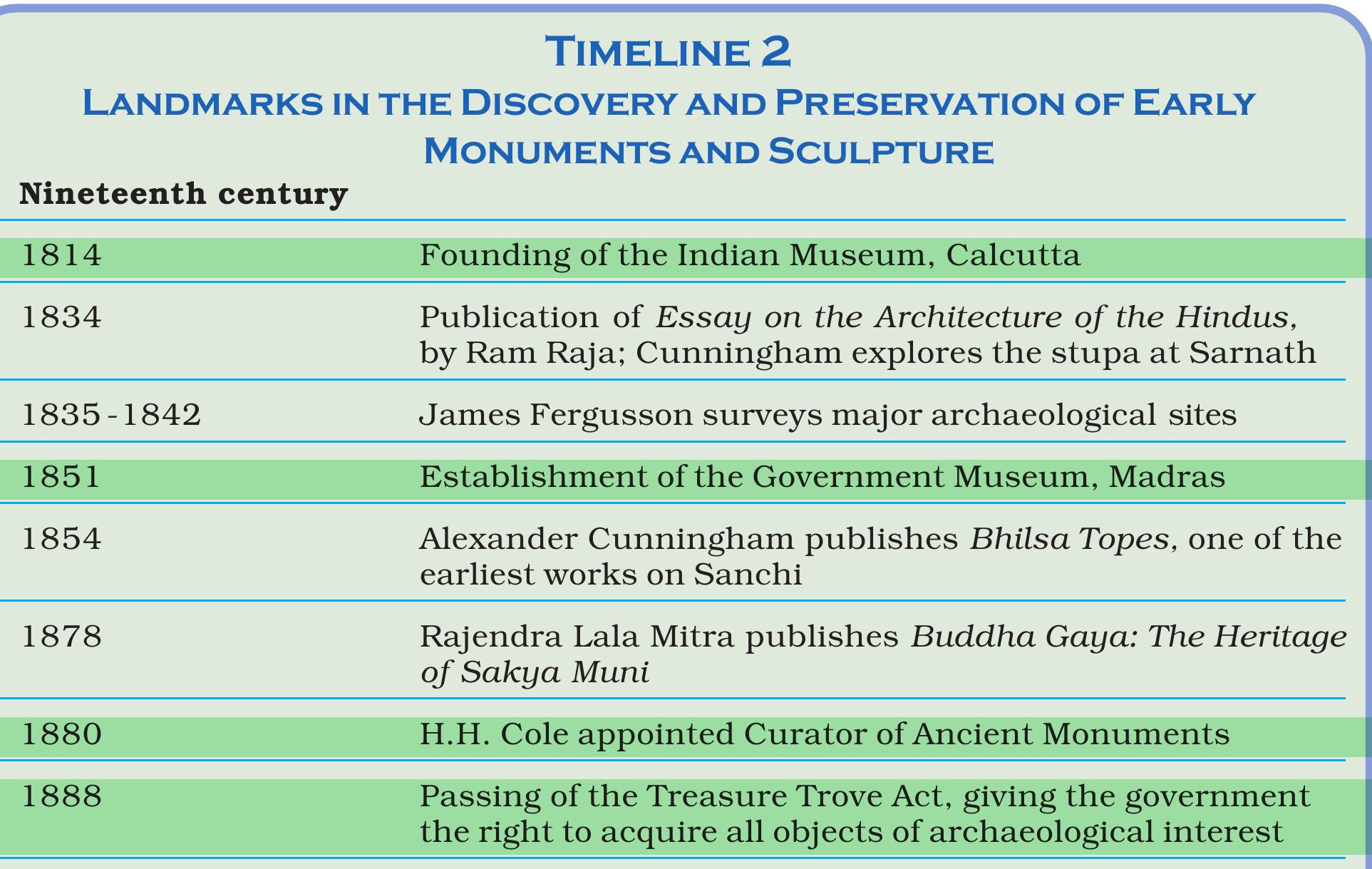
Arrange the following historical events in chronological order:
A. Establishment of the Government Museum, Madras
B. Founding of the Indian Museum, Calcutta
C. Passing of the Treasure Trove Act
D. H.H. Cole appointed Curator of Ancient Monuments
Choose the correct answer from the options given below:
Answer & explanation
Correct answer: option 3
The correct answer is Option (3) → B, A, D, C
(B) Founding of the Indian Museum, Calcutta — 1814. This was the first landmark of the nineteenth century in the discovery and preservation of early monuments and sculpture.
(A) Establishment of the Government Museum, Madras — 1851. By then sculptures from sites such as Amaravati were already being carried off to collections in Calcutta, Madras and even London.
(D) H.H. Cole appointed Curator of Ancient Monuments — 1880. Cole called the looting of ancient art ‘suicidal and indefensible’. He wanted museums to keep plaster-cast copies while the originals stayed where they had been found, and his plea for in situ preservation was adopted at Sanchi.
(C) Passing of the Treasure Trove Act — 1888. This Act gave the government the right to acquire all objects of archaeological interest.
NCERT (2025-26): “8. ‘Discovering’ Stupas – The Fate of Amaravati and Sanchi … One of the few men who had a different point of view was an archaeologist named H.H. Cole. He wrote: ‘It seems to me a suicidal and indefensible policy to allow the country to be looted of original works of ancient art.’ He believed that museums should have plaster-cast facsimiles of sculpture, whereas the originals should remain where they had been found. Unfortunately, Cole did not succeed in convincing the authorities about Amaravati, although his plea for in situ preservation was adopted in the case of Sanchi.…”
|