CUETMOCK
  • Pricing
  • Mentors
Log inStart freeStart free mocks→

First test, then trust

Try a free CUET mock test.

Join 5,00,000+ students who rehearsed exam day on the exact NTA screen before sitting CUET. On the web and on Android.

Start free mocks →Get the Android app
CUETMOCK

India's #1 CUET Mock Test Platform. Original NCERT-based questions on the exact NTA exam screen — trusted by 5,00,000+ students since CUET 2022.

Get it onGoogle PlayScan to download the CUETMOCK app

Mock tests

  • CUET mock test series
  • Commerce mocks
  • Humanities (Arts) mocks
  • Science mocks
  • Languages & GAT mocks
  • Free practice questions
  • Pricing

Resources

  • CUET exam guide
  • CUET syllabus
  • Universities accepting CUET
  • Expert blogs
  • News & notifications
  • Webinars & counselling
  • CUET score calculator
  • How we estimate your rank
  • FAQs

Company

  • About us
  • Our leadership & team
  • Our toppers
  • Mentors
  • For schools
  • Contact us
  • Terms
  • Privacy
  • Refund policy

Talk to us

+91 7696 6630 56info@cuetmock.comWhatsApp us

Our other platforms

  • JEE Mock — For IIT-JEE aspirants
  • NEET Mock — For NEET aspirants

Newsletter

Exam updates, study material and offers — no spam.

© 2026 NYC Ventures Pvt. Ltd.

701-702, Royal Business Park, Zirakpur, Punjab - 140603

  • Terms of use
  • Privacy policy
  • Refund policy
  • Contact us

iCUETMOCK is an independent preparation platform, not affiliated with the National Testing Agency (NTA). Always check exam details on the official NTA website.

  • Home
  • Mock tests
  • CUET guide
  • Pricing
  • Log in
Home/Practice questions/Geography
GeographyIndia-People and Economy: Land resources and Agriculture

Which of the following programmes was based on productive irrigation…

Read the passage and answer the questions:

Types of Farming

On the basis of the main source of moisture for crops, the farming can be classified as irrigated and rainfed (barani). There is a difference in the nature of irrigated farming, as well as based on the objective of irrigation, i.e., protective or productive.

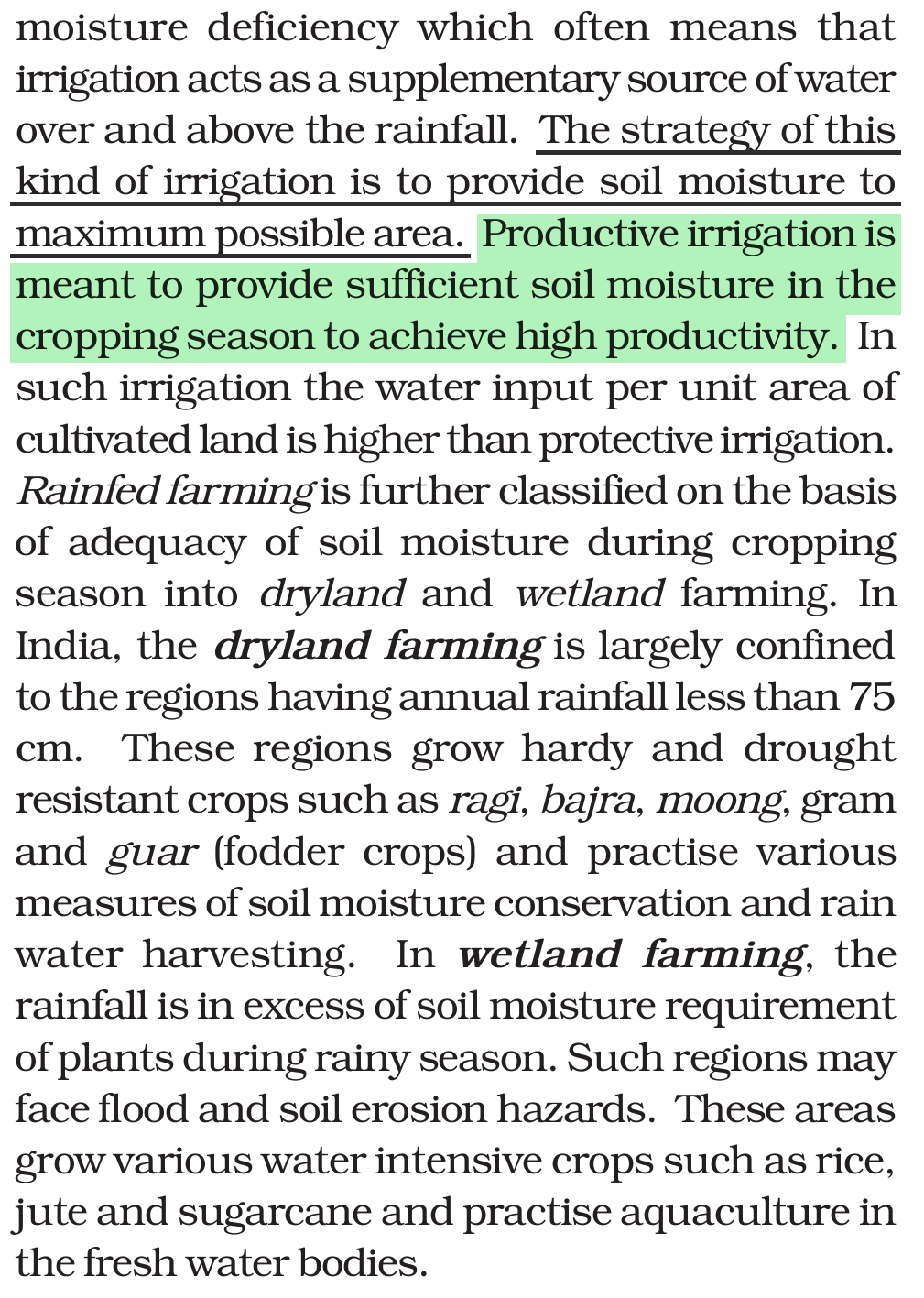
The objective of protective irrigation is to protect the crops from adverse effects of moisture deficiency, which often means that irrigation acts as a supplementary source of water over and above the rainfall. The strategy of this kind of irrigation is to provide soil moisture to the maximum possible area. Productive irrigation is meant to provide sufficient soil moisture in the cropping season to achieve high productivity. In such irrigation, the water input per unit area of cultivated land is higher than protective irrigation.

Rainfed farming is further classified on the basis of adequacy of soil moisture during the cropping season into dryland and wetland farming. In India, dryland farming is largely confined to the regions having annual rainfall less than 75 cm. These regions grow hardy and drought resistant crops such as ragi, bajra, moong, gram and guar (fodder crops) and practise various measures of soil moisture conservation and rain water harvesting. In wetland farming, the rainfall is in excess of the soil moisture requirement of plants during the rainy season. Such regions may face flood and soil erosion hazards. These areas grow various water intensive crops such as rice, jute and sugarcane and practise aquaculture in the fresh water bodies.

Which of the following programmes was based on productive irrigation strategy?

Answer & explanation+

Correct answer: option 1

The correct answer is Option (1) → Green Revolution

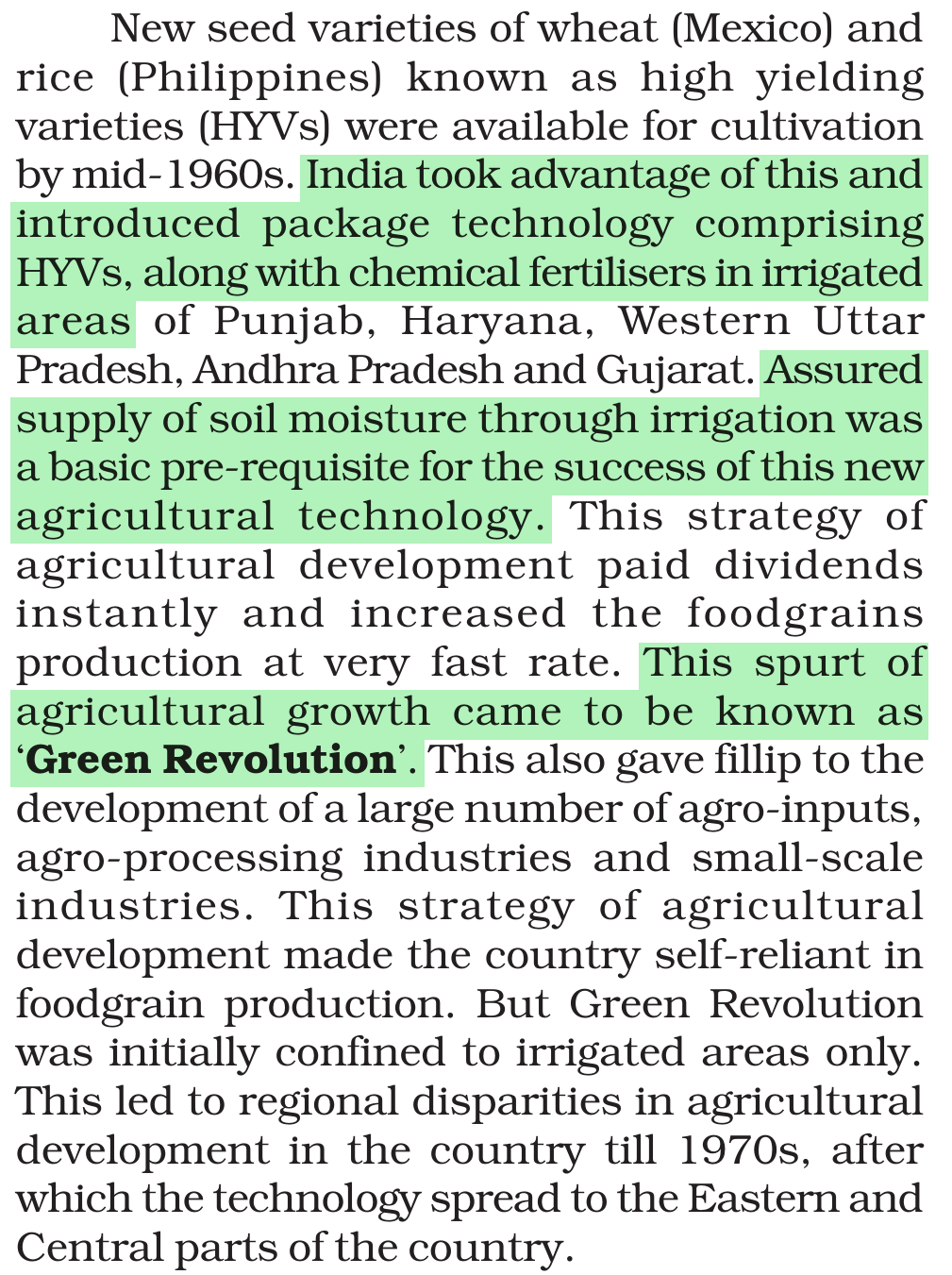
Option (1) Green Revolution — Correct. Productive irrigation gives sufficient soil moisture to achieve high productivity, with a higher water input per unit area. The Green Revolution brought high yielding varieties with chemical fertilisers to irrigated areas; these seeds give their high yield only when the soil never runs short of water, so an assured supply of soil moisture through irrigation was a basic pre-requisite for its success.

Option (2) Land reforms — Incorrect. Land reforms dealt with who owns the land, not with how much water it gets.

Option (3) Small Farmers Development Agency — Incorrect. It is a target group programme for small farmers, not an irrigation strategy.

Option (4) Agro-climatic zonation — Incorrect. Agro-climatic planning (1988) turned to rainfed areas, the very areas the irrigated Green Revolution had left out.


NCERT: India - People and Economy — Chapter 3: Land Resources and Agriculture, Types of Farming; Agricultural Development in India (2025-26)

NCERT extractNCERT extract

Advertisement

Practise more on India-People and Economy: Land resources and Agriculture

Chapter-wise mocks on the real NTA exam screen, with solutions and your rank. Your first mocks are free.

Start free mocks →

Advertisement

Next questions

  1. For the function f(x)=|cos x| , which of the following statements are correct ?(A) f(x) is continuous for all x∈ R (B) f(x) is differentiab…Maths. Section B1 · Continuity and Differentiability
  2. If y=log_3(log x) , (Consider log_ex=log x ) then the value of displaystyledy/dx isMaths. Section B1 · Continuity and Differentiability
  3. Find out which of the figures can be formed from the pieces given in Figure (X):General Aptitude Test · Non-Verbal Reasoning
  4. Which text describes, ‘how a queen named Kamalavati persuaded her husband to renounce the world’?History · Ancient India: Thinkers, Beliefs and Buildings
  5. Gabriel phthalimide synthesis of amines producesChemistry · Organic: Amines
  6. Mutualism indicates:Biology · Organisms and Populations
  7. Which one of the following was not an outcome of the elections in 1989?Political Science · Politics in India Since Independence: Recent Developments in Indian Politics
  8. “It involves synchronization of the different actions or efforts of the various units of an organization”. Identify the function of managem…Business Studies · Nature and significance of Management
  9. Which of the following were the consequences of shock therapy administered in post-communist regimes?(A) People lost their savings due to h…Political Science · Contemporary World Politics: End of Bi-Polarity
  10. The Financial Incentives are:(A) Bonus(B) Co-partnership(C) Status(D) PerquisitesChoose the correct answer from the options given below:Business Studies · Directing