The haloarene can not be prepared by
Answer & explanation
Correct answer: option 2
The correct answer is Option (2) → Fittig reaction of chlorobenzene
A haloarene has a halogen atom attached directly to a benzene ring. A method prepares a haloarene only if the product still carries a halogen on the ring.
Option (1) Sandmeyer reaction of aniline — Prepares a haloarene. Aniline is first diazotised, and CuCl/HCl then replaces the –\( \ce{N2^{+}} \) group by Cl, giving chlorobenzene.
\( \displaystyle \ce{C6H5NH2 + NaNO2 + 2HCl} \xrightarrow{\text{273-278 K}} \ce{C6H5N2^+Cl^- + NaCl + 2H2O} \)
\( \displaystyle \ce{C6H5N2^+Cl^-} \xrightarrow{\ce{CuCl}\text{/}\ce{HCl}} \ce{C6H5Cl + N2} \)
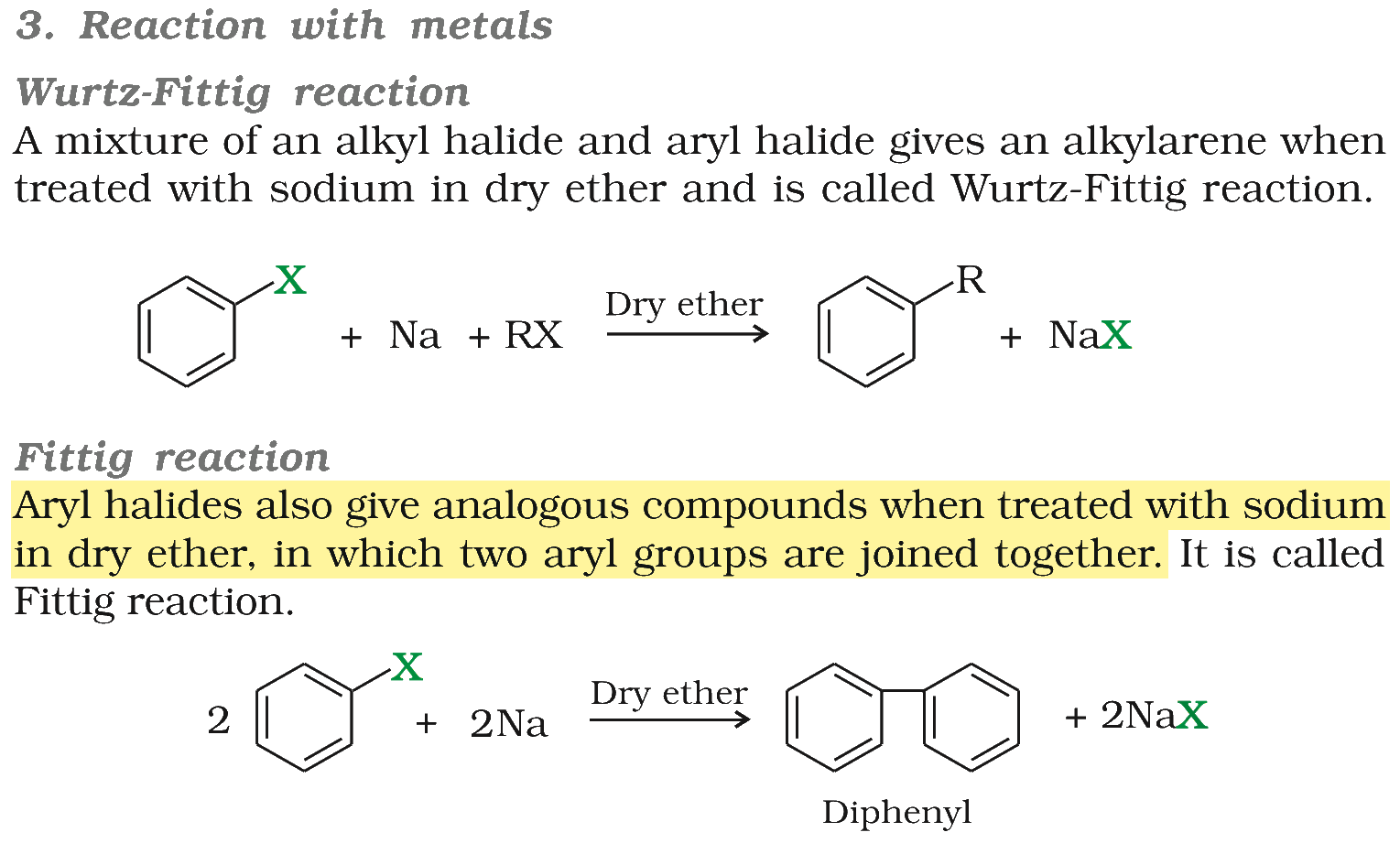
Option (2) Fittig reaction of chlorobenzene — Cannot prepare a haloarene. In the Fittig reaction an aryl halide is treated with sodium in dry ether. The halogen atoms are removed as NaCl and the two aryl groups join to form biphenyl, a hydrocarbon:
\( \displaystyle \ce{2C6H5Cl + 2Na} \xrightarrow{\text{dry ether}} \ce{C6H5-C6H5 + 2NaCl} \)
Option (3) heating benzenediazonium chloride with potassium iodide — Prepares a haloarene. Iodide ions replace the diazonium group directly, without a copper catalyst, giving iodobenzene.
\( \displaystyle \ce{C6H5N2^+Cl^- + KI -> C6H5I + KCl + N2} \)
Option (4) Friedel-Crafts alkylation of chlorobenzene — Prepares a haloarene. A methyl group enters the ring but the chlorine stays, so the products, 2-chlorotoluene and 4-chlorotoluene, are still haloarenes.
\( \displaystyle \ce{C6H5Cl + CH3Cl} \xrightarrow{\text{anhyd. }\ce{AlCl3}} \ce{CH3C6H4Cl + HCl} \)
NCERT (2026-27 edition):
Reaction with Metals