
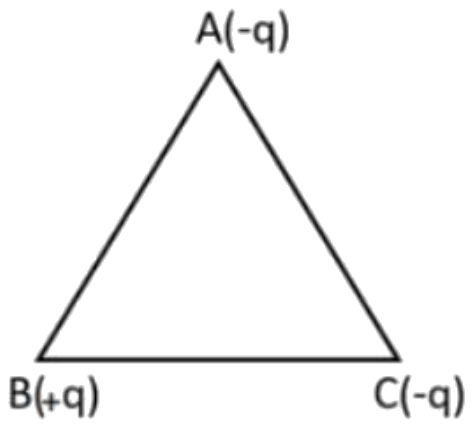
Three point charges \( (-q) \), \( (+q) \) and \( (-q) \) are placed at three corners of an equilateral triangle ABC as shown in the figure below. The net electrostatic force at point A will act:
Answer & explanation
Correct answer: option 2
The correct answer is Option (2) → along negative \( x \)-axis.
The force on the charge at A is the vector sum of the two Coulomb forces: unlike charges attract and like charges repel.
Take the \( x \)-axis along BC (from B towards C) and the \( y \)-axis upwards, towards A. Both forces have the same magnitude \( F = kq^{2}/a^{2} \), where \( a \) is the side of the triangle, and each acts along a side that makes \( 60^{\circ} \) with BC.
B \( (+q) \) attracts A \( (-q) \), so \( \vec{F}_{B} \) points along AB, towards B (down and to the left).
C \( (-q) \) repels A \( (-q) \), so \( \vec{F}_{C} \) points along CA produced, away from C (up and to the left).
\( \vec{F}_{B} = F(-\cos60^{\circ}\,\hat{\imath} - \sin60^{\circ}\,\hat{\jmath}) \)
\( \vec{F}_{C} = F(-\cos60^{\circ}\,\hat{\imath} + \sin60^{\circ}\,\hat{\jmath}) \)
The \( y \)-components cancel and the \( x \)-components add:
\( \vec{F}_{\mathrm{net}} = -2F\cos60^{\circ}\,\hat{\imath} = -F\,\hat{\imath} \)
So the net force at A acts along the negative \( x \)-axis, parallel to CB.