Which of the following undergoes fastest nucleophilic substitution reaction?
Answer & explanation
Correct answer: option 4
The correct answer is Option (4) → 1-chloro-4-nitrobenzene
Aryl halides are much less reactive than alkyl halides towards nucleophilic substitution. The C–Cl bond has partial double bond character due to resonance, the carbon is sp2 hybridised, and the electron-rich ring repels the incoming nucleophile.
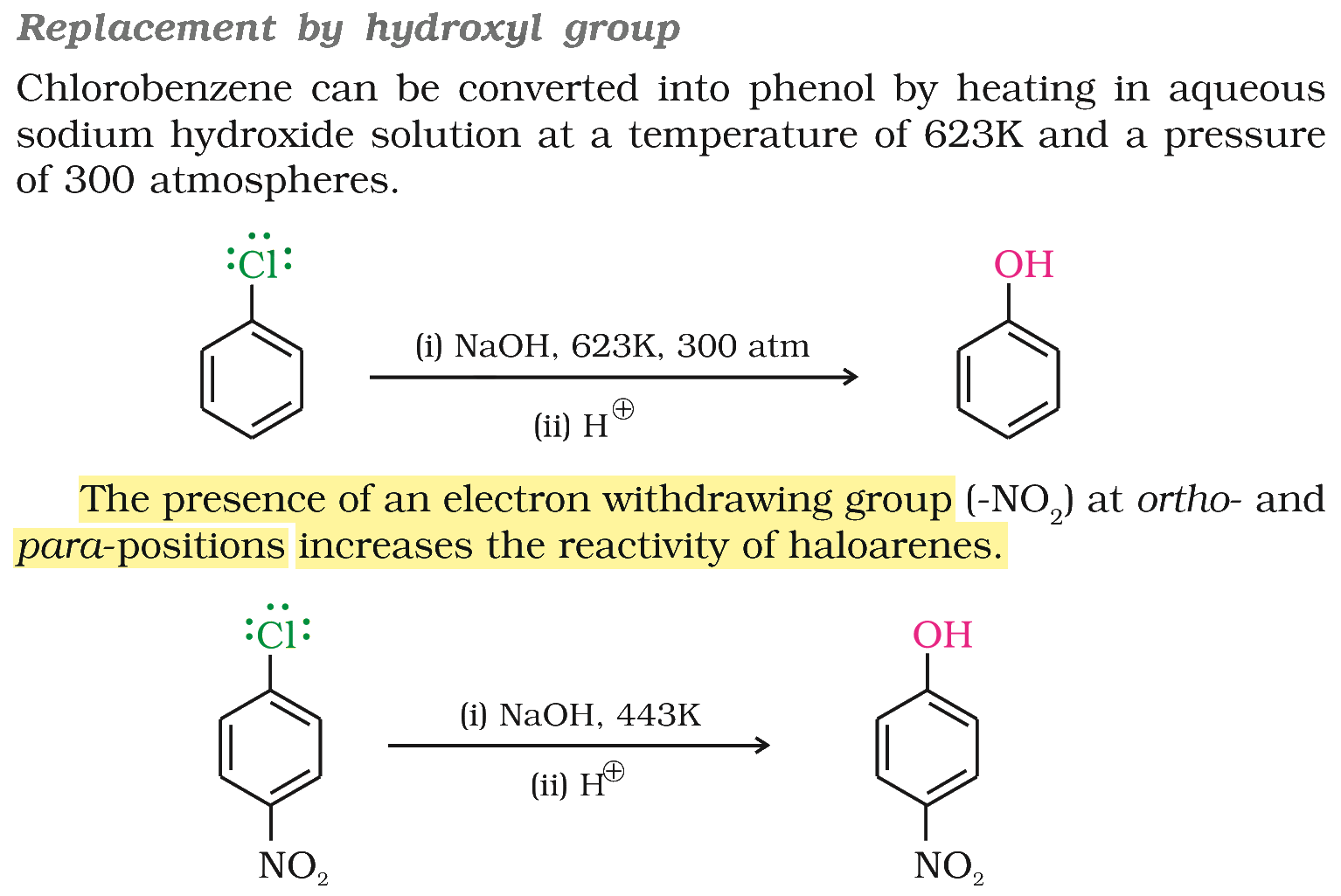
The reactivity increases when an electron withdrawing group such as –\( \ce{NO2} \) is present at the ortho or para position. The nucleophile adds to the ring to form a negatively charged intermediate, and the –\( \ce{NO2} \) group at the para position delocalises this negative charge onto its oxygen atoms by resonance. This stabilises the intermediate and speeds up the reaction. Electron donating groups do the opposite.
The conditions needed to replace Cl by OH show the effect:
\( \displaystyle \ce{C6H5Cl} \xrightarrow[\text{(ii) }\ce{H+}]{\text{(i) }\ce{NaOH}\text{, 623 K, 300 atm}} \ce{C6H5OH} \)
\( \displaystyle \text{1-chloro-4-nitrobenzene} \xrightarrow[\text{(ii) }\ce{H+}]{\text{(i) }\ce{NaOH}\text{, 443 K}} \text{4-nitrophenol} \)
So 1-chloro-4-nitrobenzene undergoes nucleophilic substitution fastest.
Why the other options are incorrect
Option (1) Chlorobenzene — Incorrect. It has no activating group and reacts only under drastic conditions.
Option (2) 1-chloro-4-methylbenzene — Incorrect. The –\( \ce{CH3} \) group releases electrons by +I effect and hyperconjugation, which destabilises the negative intermediate, so it reacts more slowly than chlorobenzene.
Option (3) 1-chloro-4-methoxybenzene — Incorrect. The –\( \ce{OCH3} \) group releases electrons strongly by resonance (+R), so it also reacts more slowly than chlorobenzene.
NCERT (2026-27 edition):
Reactions of Haloarenes – …