
CUETMOCK
  • Pricing
  • Mentors
Log inStart freeStart free mocks→

First test, then trust

Try a free CUET mock test.

Join 5,00,000+ students who rehearsed exam day on the exact NTA screen before sitting CUET. On the web and on Android.

Start free mocks →Get the Android app
CUETMOCK

India's #1 CUET Mock Test Platform. Original NCERT-based questions on the exact NTA exam screen — trusted by 5,00,000+ students since CUET 2022.

Get it onGoogle PlayScan to download the CUETMOCK app

Mock tests

  • CUET mock test series
  • Browse all papers
  • Commerce mocks
  • Humanities (Arts) mocks
  • Science mocks
  • Languages & GAT mocks
  • Free practice questions
  • Pricing

Resources

  • CUET exam guide
  • CUET syllabus
  • Universities accepting CUET
  • Expert blogs
  • News & notifications
  • Webinars & counselling
  • CUET score calculator
  • How we estimate your rank
  • FAQs

Company

  • About us
  • Our leadership & team
  • Our toppers
  • Mentors
  • For schools
  • Contact us
  • Terms
  • Privacy
  • Refund policy

Talk to us

+91 7696 6630 56info@cuetmock.comWhatsApp us

Our other platforms

  • JEE Mock — For IIT-JEE aspirants
  • NEET Mock — For NEET aspirants

Newsletter

Exam updates, study material and offers — no spam.

© 2026 NYC Ventures Pvt. Ltd.

701-702, Royal Business Park, Zirakpur, Punjab - 140603

  • Terms of use
  • Privacy policy
  • Refund policy
  • Contact us

iCUETMOCK is an independent preparation platform, not affiliated with the National Testing Agency (NTA). Always check exam details on the official NTA website.

  • Home
  • Mock tests
  • CUET guide
  • Pricing
  • Log in
Home/Practice questions/Chemistry
ChemistryPhysical: Electro Chemistry

The standard reduction potential of the given half cell, H+(aq) + e−…

The standard reduction potential of the given half cell, H+(aq) + e− → ½H2, is:

Answer & explanation+

Correct answer: option 2

The correct answer is Option (2) → 0 V

The standard hydrogen electrode is the reference electrode, and by convention its reduction potential is zero:

    \( \displaystyle \ce{H^+(aq) + e^- -> 1/2 H2(g)} \qquad E^{\circ}=0\ \mathrm{V} \)

NCERT (2026-27 edition):
Measurement of Electrode Potential
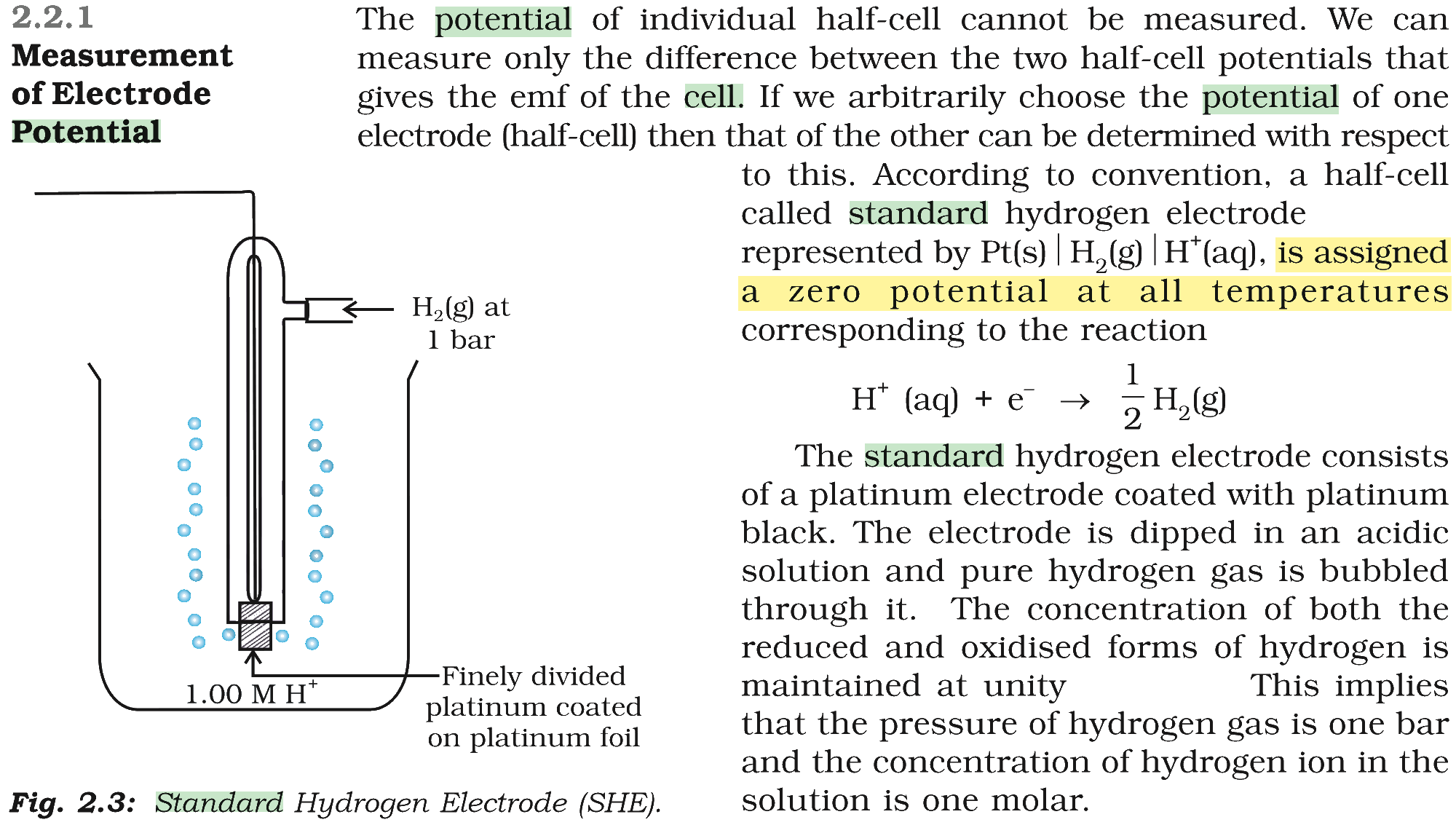
Textbook extract

Advertisement

Practise more on Physical: Electro Chemistry

Chapter-wise mocks on the real NTA exam screen, with solutions and your rank. Your first mocks are free.

Start free mocks →

Advertisement

Next questions

  1. What is the molecularity of the given elementary reaction?2NO + O2 → 2 NO2Chemistry · Physical: Chemical Kinetics
  2. Which one of the following compounds gives a positive Fehling's Test?Chemistry · Organic: Aldehydes, Ketones and Carboxylic Acids
  3. [Co(NH3)5(NO2)]Cl2 exhibits....Chemistry · Inorganic: Coordination Compounds
  4. The features of wind-pollinated flowers are:A. Well-exposed stamensB. Pollen grains light and non stickyC. Feathery stigmasD. Pollen grains…Biology · Sexual Reproduction in Flowering Plants
  5. The man, who hunted with stone weapons but ate fruit was:Biology · Evolution
  6. The mean of 30 observations was 15. Upon checking, it was found that two observations were wrongly taken as 2 and 5. If incorrect observati…General Aptitude Test · Numerical Ability
  7. Which of the following is NOT true about changes in shares of Land-use Categories in India, between 1950–51 and 2019–20?Geography · India-People and Economy: Land resources and Agriculture
  8. Two boys A and B start at the same time to ride from Delhi to Meerut, 60 km away. A travels 4 km an hour slower than B. B reaches Meerut an…General Aptitude Test · Numerical Ability
  9. CPCB stands for.Economics · Indian Economic Development: Environment and Sustainable Development
  10. Which of the following are push factors for urban to rural migration for human populationA. Air pollutionB. Good Agriculture in villagesC.…Environmental Studies