Rate law
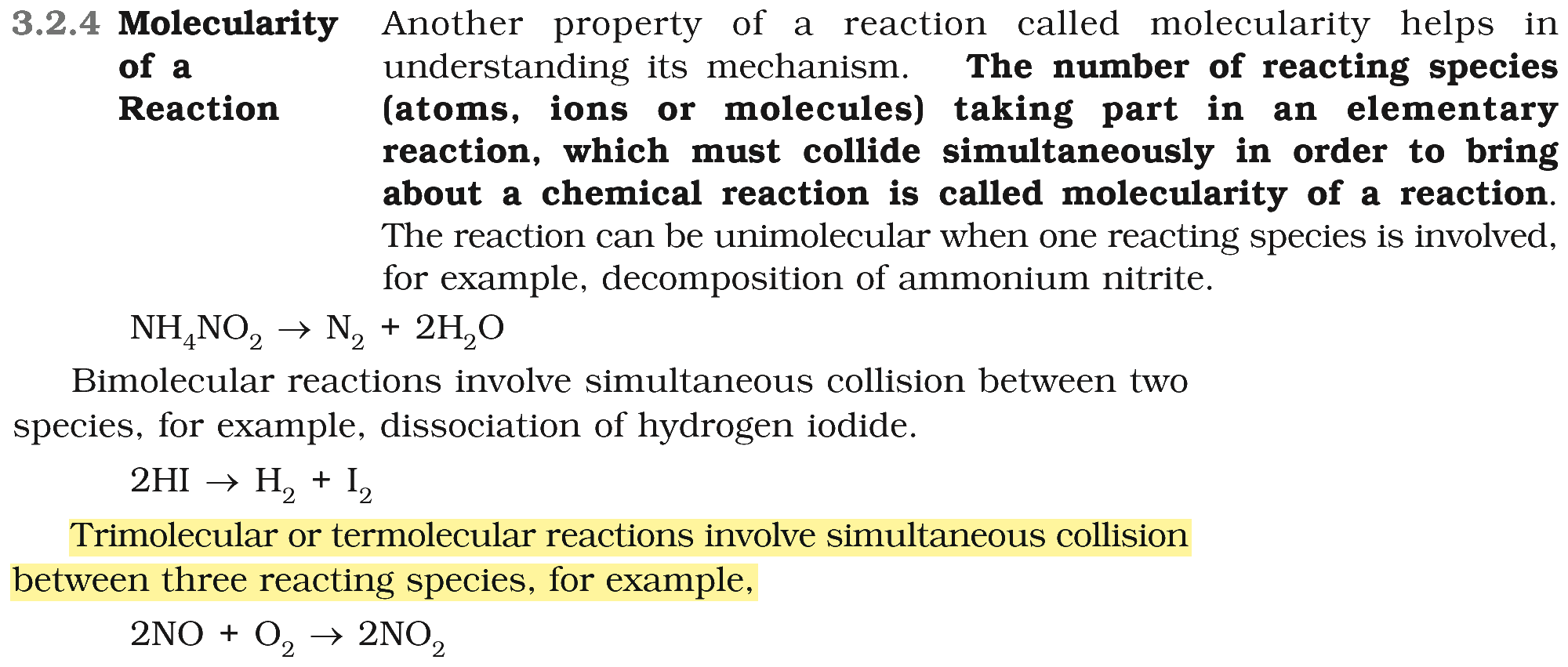
Rate law is the expression in which reaction rate is given in terms of molar concentration of reactants, with each term raised to some power, which may or may not be same as the stoichiometric coefficient of the reacting species in a balanced chemical equation. The sum of powers of the concentration of the reactants, in the rate law expression is called the order of that chemical reaction. The number of reacting species (atoms, ions, or molecules) taking part in an elementary reaction, which must collide simultaneously in order to bring about a chemical reaction, is called molecularity of a reaction.
What is the molecularity of the given elementary reaction?
2NO + O2 → 2 NO2
Answer & explanation
Correct answer: option 1
The correct answer is Option (1) → 3
The molecularity of an elementary reaction is the number of reacting species (atoms, ions or molecules) that must collide simultaneously for the reaction to occur.
In the given reaction, two molecules of NO and one molecule of \( \ce{O2} \) collide together:
\( \displaystyle \text{Molecularity}=2\ (\ce{NO})+1\ (\ce{O2})=3 \)
NCERT (2026-27 edition):
Molecularity of a Reaction