
Find the foot of perpendicular from the point $(2, 3, -8)$ to the line $\frac{4 - x}{2} = \frac{y}{6} = \frac{1 - z}{3}$. Also, find the perpendicular distance from the given point to the line.
Answer & explanation
Correct answer: option 1
The correct answer is Option (1) → Foot: $(2, 6, -2)$; Distance: $3\sqrt{5}$ units ##
We have, equation of line as $\frac{4 - x}{2} = \frac{y}{6} = \frac{1 - z}{3}$
$\Rightarrow \frac{x - 4}{-2} = \frac{y}{6} = \frac{z - 1}{-3} = \lambda$
$\Rightarrow x = -2\lambda + 4, \ y = 6\lambda \text{ and } z = -3\lambda + 1$
Let the coordinates of $L$ be $(4 - 2\lambda, 6\lambda, 1 - 3\lambda)$ and direction ratios of $PL$ are proportional to $(4 - 2\lambda - 2, 6\lambda - 3, 1 - 3\lambda + 8)$ i.e., $(2 - 2\lambda, 6\lambda - 3, 9 - 3\lambda)$.
Also, direction ratios are proportional to $-2, 6, -3$. Since, $PL$ is perpendicular to given line.
$∴-2(2 - 2\lambda) + 6(6\lambda - 3) - 3(9 - 3\lambda) = 0$
$\Rightarrow -4 + 4\lambda + 36\lambda - 18 - 27 + 9\lambda = 0$
$\Rightarrow 49\lambda = 49 \Rightarrow \lambda = 1$
So, the coordinates of $L$ are $(4 - 2\lambda, 6\lambda, 1 - 3\lambda)$ i.e., $(2, 6, -2)$.
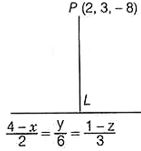
Now, length of $PL = \sqrt{(2 - 2)^2 + (6 - 3)^2 + (-2 + 8)^2}$
$= \sqrt{0 + 9 + 36} = 3\sqrt{5} \text{ units}$