The letter 'D' in \(D-(+)-\)glucose signifies
Answer & explanation
Correct answer: option 4
The correct answer is Option (4) → Configuration at lowest asymmetric carbon
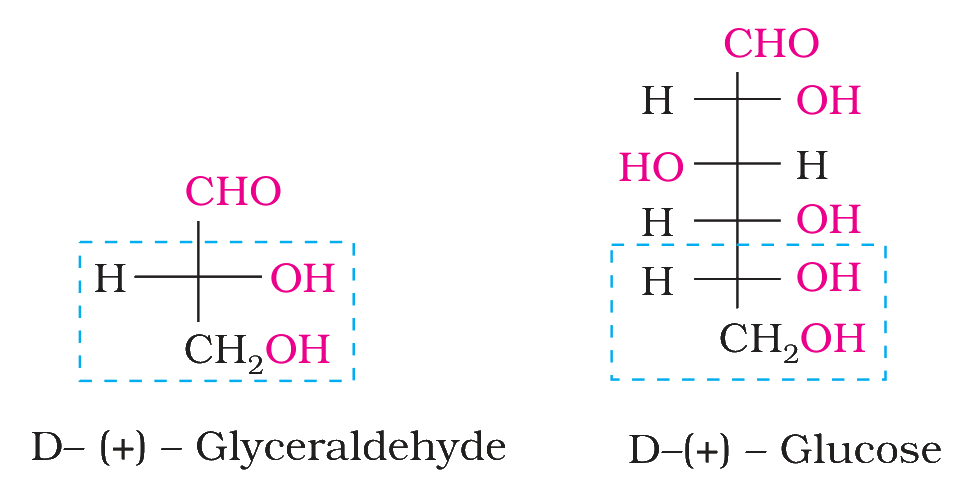
In D-(+)-glucose, ‘D’ shows the relative configuration, while ‘(+)’ shows that glucose is dextrorotatory. The configuration is fixed by comparing glucose with glyceraldehyde: in the Fischer projection of (+)-glucose the –OH on the lowest asymmetric carbon (C-5) is on the right side, as in D-(+)-glyceraldehyde, so glucose is assigned the D-configuration.
Why the other options are incorrect
Option (1) Configuration at all chiral carbons — Incorrect. Glucose has four chiral carbons (C-2 to C-5) with OH groups on both sides; D refers only to the lowest one.
Option (2) Dextrorotatory — Incorrect. Rotation is shown by the sign ‘(+)’; ‘D’ and ‘L’ have no relation with optical activity (D-fructose, for example, is laevorotatory).
Option (3) It is monosaccharide — Incorrect. The letter D does not describe the class of carbohydrate.
NCERT (2026-27 edition):
Glucose – …

“… For assigning the configuration of monosaccharides, it is the lowest asymmetric carbon atom (as shown below) which is compared. As in (+) glucose, —OH on the lowest asymmetric carbon is on the right side which is comparable to (+) glyceraldehyde, so (+) glucose is assigned D-configuration.”