
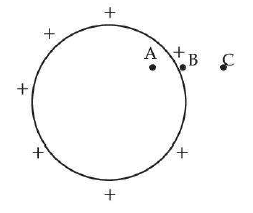
For a given charged conducting hollow sphere arrange the electric field at the given points A, B and C in decreasing order :
Answer & explanation
Correct answer: option 1
The correct answer is Option (1) → \( E_B \gt E_C \gt E_A \)
For a charged conductor the charge sits on the outer surface. Gauss's law with a spherical surface of radius \( r \) gives the field of a charged hollow (or solid) conducting sphere of radius \( R \):
\( \displaystyle E = 0 \quad (r \lt R), \qquad E = \frac{1}{4\pi\varepsilon_0}\,\frac{Q}{r^{2}} \quad (r \ge R) \)
From the figure: A is inside the sphere, B is on the surface and C is outside, farther from the centre.
\( E_A = 0 \)
\( \displaystyle E_B = \frac{1}{4\pi\varepsilon_0}\,\frac{Q}{R^{2}} \)
\( \displaystyle E_C = \frac{1}{4\pi\varepsilon_0}\,\frac{Q}{r_C^{2}} \lt E_B \quad (r_C \gt R) \)
The field is zero inside, largest at the surface, and falls as \( 1/r^{2} \) outside. So the decreasing order is \( E_B \gt E_C \gt E_A \).
NCERT (2026-27):
Summary – “… (iii) Thin spherical shell of uniform surface charge density σ
\( \displaystyle \mathbf{E} = \frac{q}{4\pi\varepsilon_0 r^2}\,\hat{\mathbf{r}} \quad (r \ge R), \qquad \mathbf{E} = 0 \quad (r \lt R) \)
where r is the distance of the point from the centre of the shell and R the radius of the shell. … The electric field outside the shell is as though the total charge is concentrated at the centre. … The field is zero at all points inside the shell.”