Match List-I with List-II
| List-I | List-II | ||
| Approaches to Human Geography | Broad Features | ||
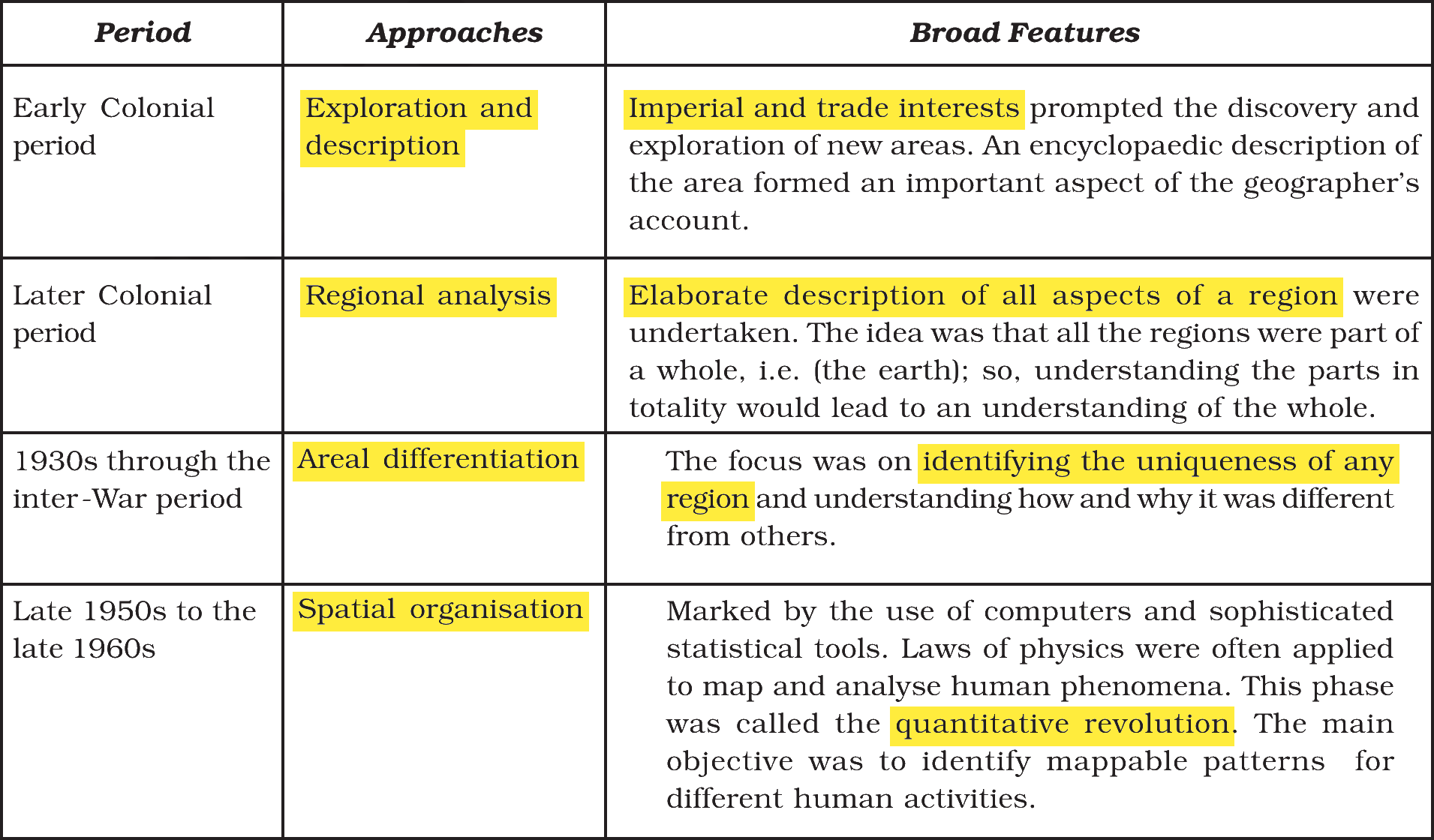
| (A) | Regional analysis | (I) | The focus was on identifying the uniqueness of any region. |
| (B) | Areal differentiation | (II) | Elaborate description of all aspects of a region. |
| (C) | Spatial organisation | (III) | Imperial and trade interests oriented. |
| (D) | Exploration and description | (IV) | This phase was called the quantitative revolution. |
Choose the correct answer from the options given below:
Answer & explanation
Correct answer: option 3
The correct answer is Option (3) → (A)-(II), (B)-(I), (C)-(IV), (D)-(III)
(A) Regional analysis — this matches (II) Elaborate description of all aspects of a region. This was the approach of the later colonial period.
(B) Areal differentiation — this matches (I) The focus was on identifying the uniqueness of any region. It looked at how and why one region differs from others.
(C) Spatial organisation — this matches (IV) This phase was called the quantitative revolution. Computers and statistical tools were used to map human activities.
(D) Exploration and description — this matches (III) Imperial and trade interests oriented. In the early colonial period, trade interests led to the discovery of new areas.
NCERT (2026-27): Fundamentals of Human Geography — Chapter 1: Human Geography: Nature and Scope
Table 1.1: Broad Stages and Thrust of Human Geography |