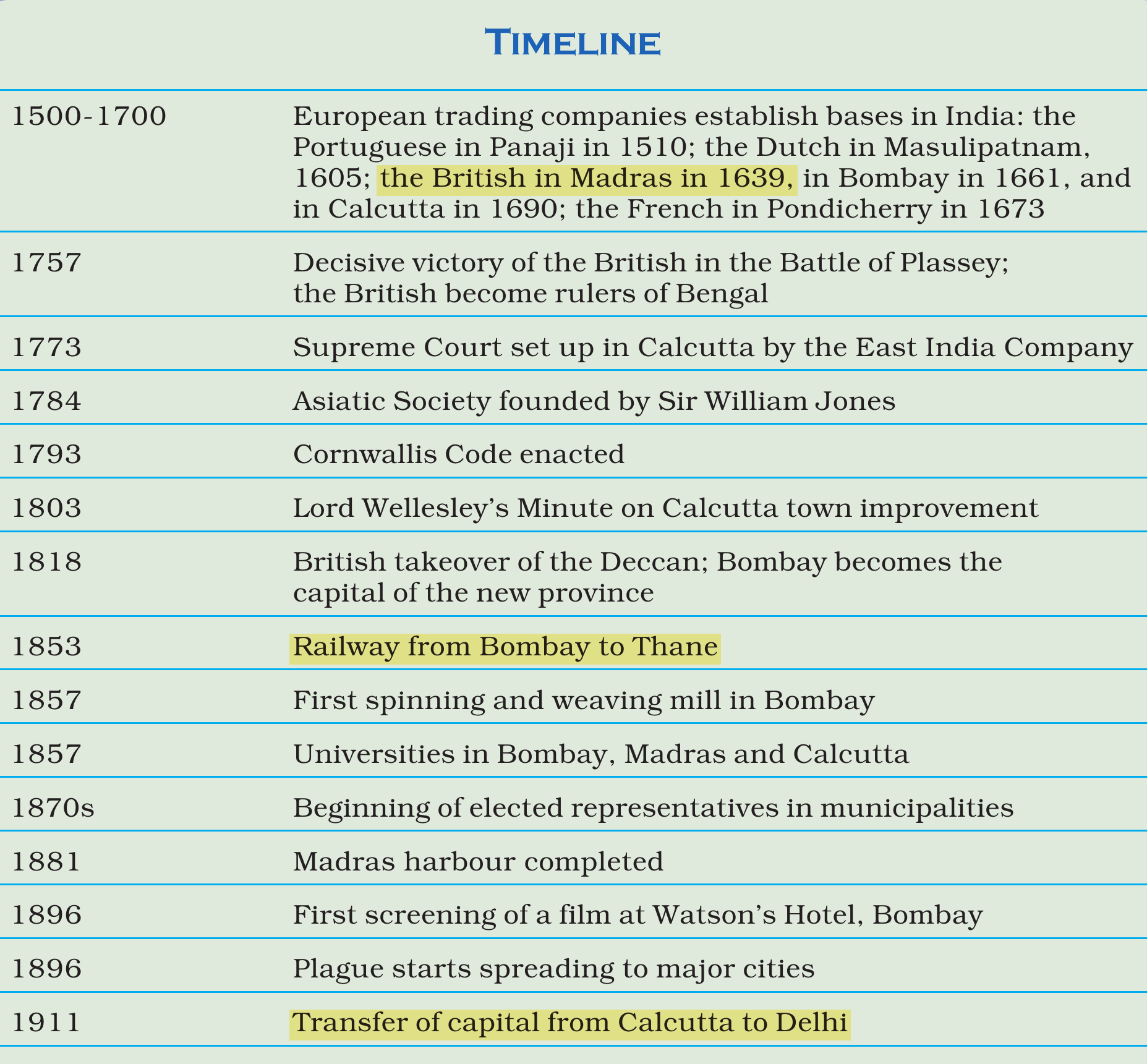
Arrange the following events related to the establishment of British empire in India in chronological order:
(A) Establishment of railways in India by the British
(B) Lottery Committee
(C) First all India Census
(D) British set up trading post in Madras
(E) Transfer of Capital from Calcutta to Delhi
Choose the correct answer from the options given below:
Answer & explanation
Correct answer: option 1
The correct answer is Option (1) → (D), (B), (A), (C), (E)
(D) British set up trading post in Madras — 1639, at Madraspatam; the Company had bought the right of settlement from the Nayaks of Kalahasti.
(B) Lottery Committee — 1817. It carried on the town planning of Calcutta after Wellesley left, raising funds through public lotteries.
(A) Establishment of railways in India by the British — 1853, when the first railway ran from Bombay to Thane.
(C) First all India Census — 1872; from 1881 the census was held every ten years.
(E) Transfer of Capital from Calcutta to Delhi — 1911.
Note: This question is taken from the chapter ‘Colonial Cities’ which was there in the pre-rationalised NCERT and has been deleted from subsequent editions of NCERT, including the NCERT book (2026-27).
NCERT (Pre-rationalised): “4.1 Settlement and segregation in Madras … The Company had first set up its trading activities in the well-established port of Surat on the west coast. Subsequently the search for textiles brought British merchants to the east coast. In 1639 they constructed a trading post in Madraspatam. This settlement was locally known as Chenapattanam. The Company had purchased the right of settlement from the local Telugu lords, the Nayaks of Kalahasti, who were eager to support trading activity in the region.… 4.2 Town planning in Calcutta … After Wellesley’s departure the work of town planning was carried on by the Lottery Committee (1817) with the help of the government. The Lottery Committee was so named because funds for town improvement were raised through public lotteries. In other words, in the early decades of the nineteenth century raising funds for the city was still thought to be the responsibility of public-minded citizens and not exclusively that of the government.… 2.2 Trends of change … The introduction of railways in 1853 meant a change in the fortunes of towns. Economic activity gradually shifted away from traditional towns which were located along old routes and rivers. Every railway station became a collection depot for raw materials and a distribution point for imported goods.… 2.1 Colonial records and urban history … The growth of cities was monitored through regular head-counts. By the mid-nineteenth century several local censuses had been carried out in different regions. The first all-India census was attempted in 1872. Thereafter, from 1881, decennial (conducted every ten years) censuses became a regular feature.…”
|