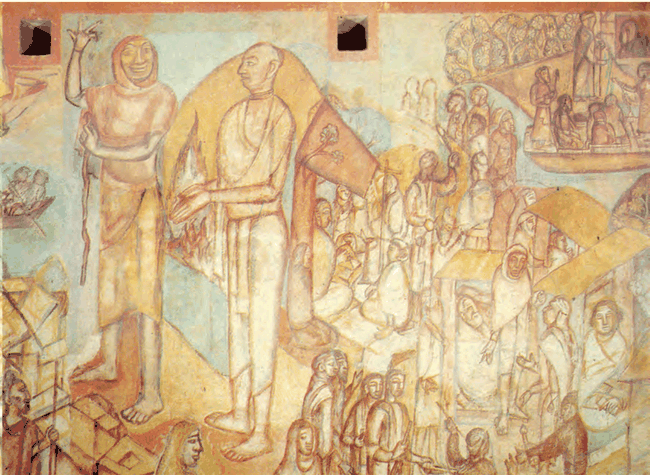
Benode Behari Mukherjee painted the mural The Lives of Medieval Saints. Which of the following statements about it are NOT correct?
(A) The mural was made during 1946–1947, on the eve of India’s Independence.
(B) The artist had perfect eyesight while painting the mural.
(C) The mural covers the three walls of the room from floor to ceiling.
(D) The mural employs the technique of fresco buono.
Choose the correct answer from the options given below:
Answer & explanation
Correct answer: option 4
The correct answer is Option (4) → (B) and (C) only
(A) The mural was made during 1946–1947, on the eve of India’s Independence. — Correct. It was painted around the eve of Independence from Colonial rule.
(B) The artist had perfect eyesight while painting the mural. — Incorrect. The artist had poor eyesight, yet he sketched straight on the walls.
(C) The mural covers the three walls of the room from floor to ceiling. — Incorrect. It covers only the upper half of the three walls.
(D) The mural employs the technique of fresco buono. — Correct. This is the technique the mural uses.
Note: This topic was not named in the CUET 2026 syllabus, but it was part of the NCERT chapter. In 2025 and 2026, NTA also asked questions on topics in NCERT that the CUET syllabus did not name. So our mocks have questions from every part of the NCERT chapter, to give you enough practice. Read the whole chapter, not only the sub-topics named in the syllabus.
NCERT (2026-27): “The Lives of Medieval Saints The Lives of Medieval Saints, a mural in Hindi Bhavana, Shantiniketan, was created by Benode Behari Mukherjee around the eve of India’s Independence from Colonial rule, during 1946–1947. The mural employs the technique of fresco buono and covers almost 23 metre of the entire upper half of the three walls of the room. Mukherjee skillfully reminds us of the syncretic and tolerant tradition of Indian life as found in the teachings of great Bhakti poets like Ramanuja, Kabir, Tulsidas, Surdas and others. Despite his poor eyesight, the artist sketched directly on the walls without compositional sketches.…”
|