Molecular Basis of Inheritance
Read the following passage carefully and answer the questions given below:
In the process of translation, genetic information is translated from the language of nucleic acid polymers to the language of amino acid polymers. There is no complementarity between amino acids and nucleotides, nor can this be thought of chemically. This led to the proposal of a genetic code that would direct the sequence of amino acids during protein synthesis. In eukaryotes, monocistronic structural genes are found, in which interrupted coding sequences are present. Coding sequences, or expressed sequences, are called exons. Exons are interrupted by unexpressed sequences called introns.
The length of DNA usually depends on the number of nucleotides present in it. It is a characteristic feature of an organism. For example, a bacteriophage called φ × 174 has 5386 nucleotides, bacteriophage lambda has 48502 base pairs (bp), and Escherichia coli has 4.6 × 10⁶ base pairs (bp). There are three major types of RNA: mRNA (messenger RNA), tRNA (transfer RNA), and rRNA (ribosomal RNA). In eukaryotes, RNA is needed for the synthesis of proteins in ribosomes. DNA obtained from sources such as blood, blood spots, hair, skin, bone, semen, etc. has one or more polymorphisms, which are very useful in forensic applications.
The role of transfer RNA (tRNA) during protein synthesis is:
Answer & explanation
Correct answer: option 3
The correct answer is Option (3) → To carry amino acids and read the genetic code
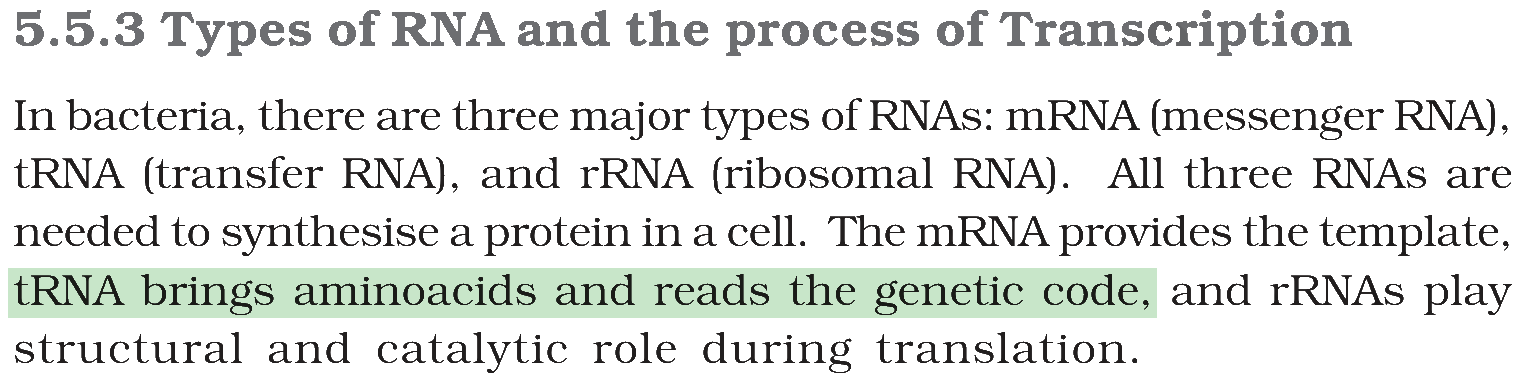
Three types of RNA take part in protein synthesis, each with its own job. mRNA provides the template. tRNA brings the amino acids and reads the genetic code: its anticodon loop pairs with the codon on the mRNA, and its other end carries the matching amino acid. rRNA plays structural and catalytic roles in the ribosome.
(1) To perform structural and catalytic roles — Incorrect. This is the job of rRNA.
(2) To provide a template — Incorrect. This is the job of mRNA.
(3) To carry amino acids and read the genetic code — Correct. tRNA is the adapter molecule between the code and the amino acids.
(4) Attachment of adenine group at the 3′ end of mRNA — Incorrect. This describes tailing, the adding of adenylate residues (poly-A tail) to the 3′ end of the RNA during processing. It is not a role of tRNA.
Note: The passage is taken from NCERT. NTA has put lines of the NCERT text together to make it. Most CUET (UG) questions come straight from NCERT, so study the book line by line, including figures and their titles.
NCERT Extract:
Transcription Unit and the Gene – …