The following steps find the returns to scale of the production function q = x10.3 x20.6. One step is missing.
(A) Output with x1 and x2 units of the inputs is q0 = x10.3 x20.6.
(B) Both inputs are increased t times (t > 1).
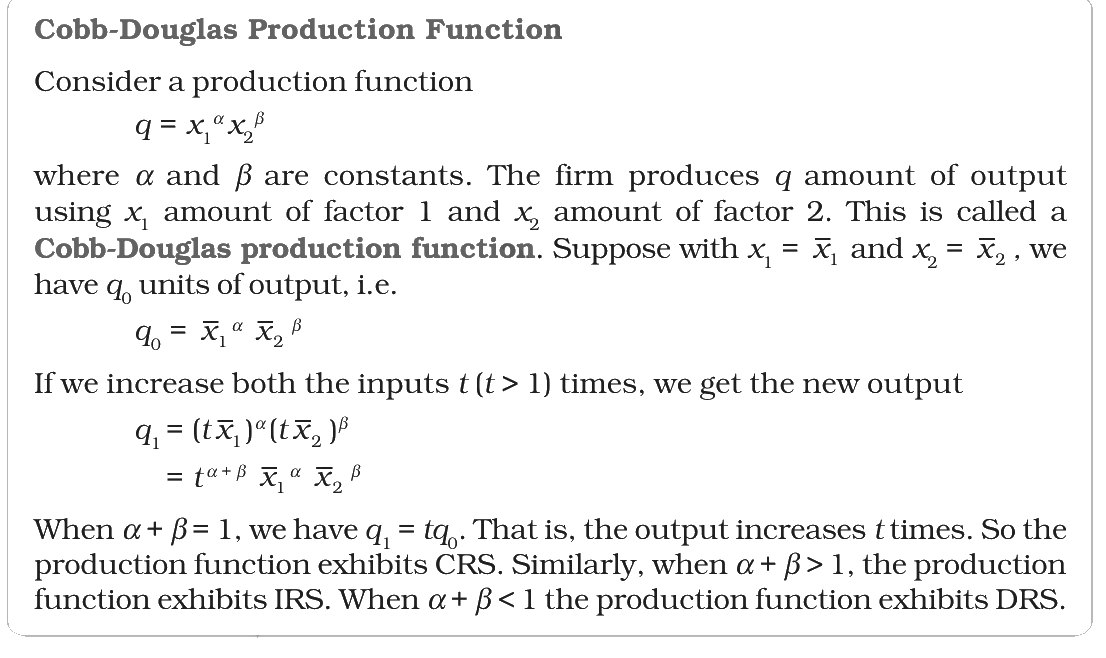
(C) The new output is q1 = (tx1)0.3 (tx2)0.6 = t0.9 q0.
(D) ______________
Which of the following is the missing step (D)?
Answer & explanation
Correct answer: option 4
The correct answer is Option (4) → Since 0.9 < 1, output rises by a smaller proportion than the inputs, so the function shows decreasing returns to scale.
Both inputs rise t times, but output rises only t0.9 times. The sum of the powers, 0.3 + 0.6 = 0.9, is less than 1, so output rises by a smaller proportion than the inputs. That is decreasing returns to scale.
Option (1) Since 0.3 is less than 0.6, the marginal product of x1 falls, so the law of variable proportions holds. — Incorrect. The law of variable proportions needs one input fixed. Here both inputs change.
Option (2) Since both inputs rise by the same proportion, the function shows constant returns to scale. — Incorrect. Raising both inputs by the same proportion is how returns to scale are tested. CRS holds only if the powers add up to 1.
Option (3) Since t0.9 is greater than 1, output rises, so the function shows increasing returns to scale. — Incorrect. Output does rise, but IRS needs it to rise by more than t times. Here it rises by less.
Option (4) Since 0.9 < 1, output rises by a smaller proportion than the inputs, so the function shows decreasing returns to scale. — Correct. Since 0.9 < 1, t0.9 is less than t.
NCERT (2026-27): “Cobb-Douglas Production Function … When α + β = 1, we have q1 = tq0. That is, the output increases t times. So the production function exhibits CRS. Similarly, when α + β > 1, the production function exhibits IRS. When α + β < 1 the production function exhibits DRS.”
|