
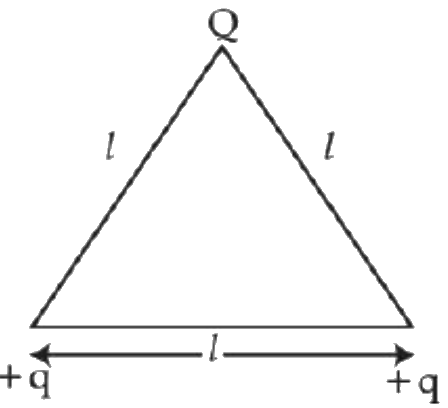
Three charges Q, +q and +q are placed at the vertices of an equilateral triangle of side \( l \), as shown in the figure. If the net electrostatic energy of the system is zero, the Q is equal to:
Answer & explanation
Correct answer: option 3
The correct answer is Option (3) → \( -\displaystyle\frac{q}{2} \)
The electrostatic potential energy of a system of point charges is the sum of \( kq_iq_j/r_{ij} \) over every pair, with \( k = 1/(4\pi\varepsilon_0) \). There are three pairs, all at separation \( l \):
\( \displaystyle U = \frac{k\,q\,q}{l} + \frac{k\,q\,Q}{l} + \frac{k\,q\,Q}{l} = \frac{k q}{l}\,(q + 2Q) \)
Putting \( U = 0 \):
\( \displaystyle q + 2Q = 0 \;\Rightarrow\; Q = -\frac{q}{2} \)