Species that are formed in one step of reaction mechanism and used up in another step are called
Answer & explanation
Correct answer: option 3
The correct answer is Option (3) → intermediates
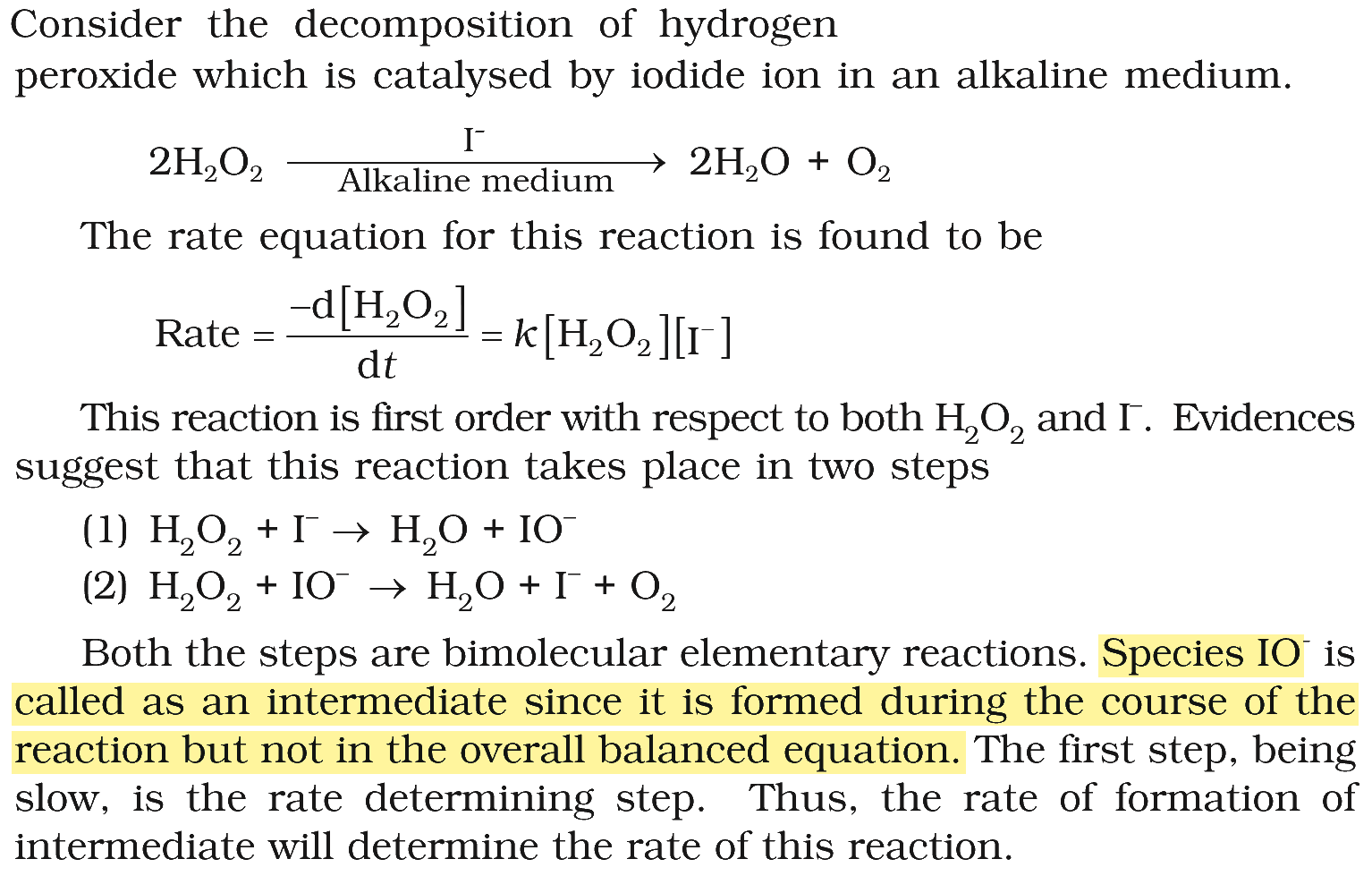
Most reactions take place through a sequence of elementary steps, called the mechanism. A species that is formed in one step and used up in a later step is a reaction intermediate; it does not appear in the balanced equation of the whole reaction.
In the iodide-catalysed decomposition of \( \ce{H2O2} \), \( \ce{IO^-} \) is formed in step (1) and consumed in step (2). Adding the two steps cancels it:
\( \displaystyle \ce{2H2O2 -> 2H2O + O2} \)
So such species are called intermediates.
Why the other options are incorrect
Option (1) catalysts — Incorrect. A catalyst works the other way round: it is used up in one step and regenerated in a later step, like \( \ce{I^{-}} \) in the example above.
Option (2) inhibitors — Incorrect. Inhibitors are substances that slow a reaction down; they are not products of one of its steps.
Option (4) promotors — Incorrect. Promoters increase the activity of a catalyst, like molybdenum for iron in the Haber process.
NCERT (2026-27 edition):
Molecularity of a Reaction – …