Binding energy per nucleon is
Answer & explanation
Correct answer: option 1
The correct answer is Option (1) → practically constant for nuclei in the range of mass number 30 < A < 170.
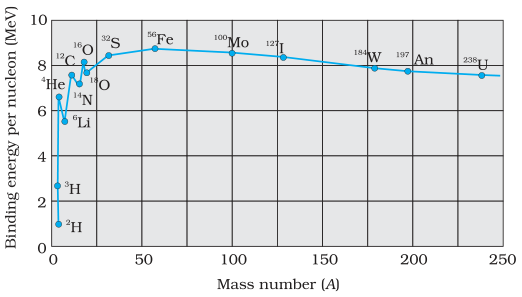
The binding energy per nucleon curve rises steeply for light nuclei, stays nearly flat at about 8 MeV for the middle range 30 < A < 170, and falls slowly for heavy nuclei. The flat part is explained by the short range (saturation) of nuclear forces: a nucleon interacts only with its close neighbours, so each nucleon gets about the same binding energy.
NCERT (2026-27):
Nuclear Binding Energy – “… Figure 13.1 is a plot of the binding energy per nucleon \( E_{bn} \) versus the mass number \( A \) for a large number of nuclei. We notice the following main features of the plot:
(i) the binding energy per nucleon, \( E_{bn} \), is practically constant, i.e. practically independent of the atomic number for nuclei of middle mass number ( 30 < A < 170). The curve has a maximum of about 8.75 MeV for A = 56 and has a value of 7.6 MeV for A = 238.
(ii) \( E_{bn} \) is lower for both light nuclei (A<30) and heavy nuclei (A>170).”