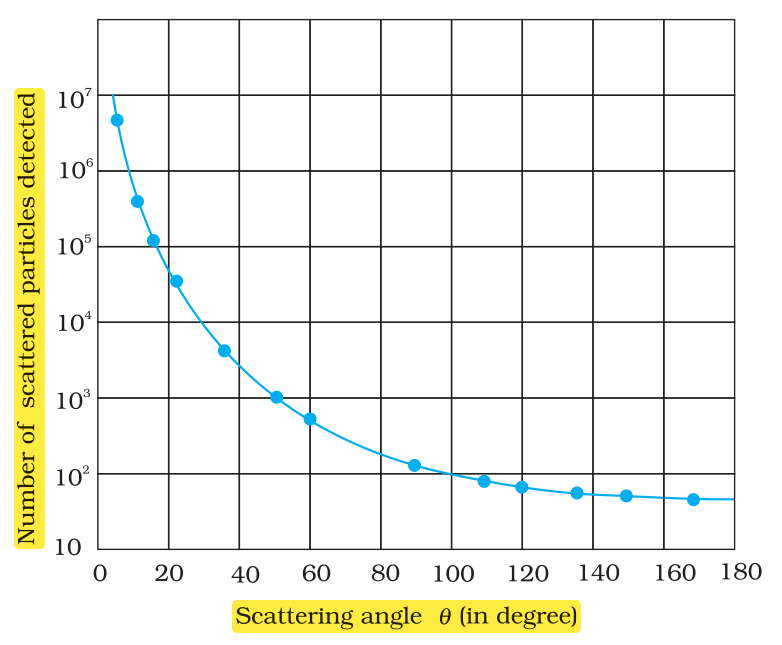
In Geiger Marsden alpha scattering experiments, a beam of alpha particles emitted from \( {}^{214}_{83}\mathrm{Bi} \) were directed to strike a gold foil and various observations were made. Now answer the following questions.
The variations of number of particles scattered N and scattering angle \( \theta \) is being represented graphically. Which one is the correct representation.
Answer & explanation
Correct answer: option 2
The correct answer is Option (2)
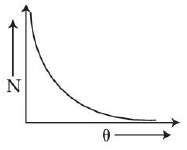
In the alpha scattering experiment most alpha particles pass through the foil almost undeflected, and only a very small fraction (about 1 in 8000) is deflected by more than \( 90^\circ \). Rutherford's scattering formula gives the number of particles scattered through an angle \( \theta \):
\( \displaystyle N(\theta) \propto \frac{1}{\sin^{4}(\theta/2)} \)
So \( N \) is very large at small angles and falls very steeply as \( \theta \) increases; at large angles (towards \( 180^\circ \)) only a very few particles are found.
For example, going from \( \theta = 10^\circ \) to \( \theta = 60^\circ \):
\( \displaystyle \frac{N(60^\circ)}{N(10^\circ)} = \left(\frac{\sin 5^\circ}{\sin 30^\circ}\right)^{4} = \left(\frac{0.087}{0.5}\right)^{4} \approx 9\times10^{-4} \)
The graph of Option (2) is the one that shows this steep fall of \( N \) with increasing \( \theta \).
NCERT (2026-27):
Alpha-Particle Scattering and Rutherford’s Nuclear Model of Atom – “… A typical graph of the total number of α-particles scattered at different angles, in a given interval of time, is shown in Fig. 12.3. … Many of the α-particles pass through the foil. It means that they do not suffer any collisions. Only about 0.14% of the incident α-particles scatter by more than 1°; and about 1 in 8000 deflect by more than 90°.”