
Which of the following reagents can be used to convert Ethanol to Ethanal?
(A) Chromium trioxide in Pyridine and $HCl$
(B) Heated Copper at 573 K
(C) Anhydrous Chromium trioxide
(D) Acidic $KMnO_4$
Choose the correct answer from the options given below:
Answer & explanation
Correct answer: option 2
The correct answer is Option (2) → (A), (B) and (C) only
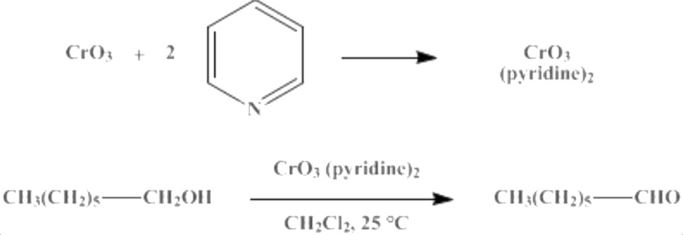
(A) Chromium trioxide in pyridine and HCI
This is a controlled chromium-based oxidizing system (similar to PCC-type reagents). Such reagents oxidize primary alcohols to aldehydes without over-oxidation to acids. Hence, ethanol can be converted to ethanal.
(B) Heated copper at 573 K
Hot copper causes dehydrogenation of ethanol:
$CH_3CH_2OH \overset{{Cu, 573 K}}{\longrightarrow} CH_3CHO + H_2$
This directly forms ethanal, so it is suitable.
(C) Anhydrous chromium trioxide
In absence of water, oxidation can stop at the aldehyde stage. Anhydrous conditions prevent formation of carboxylic acid. Thus ethanol can be converted to ethanal.

(D) Acidic $KMnO_4$
Acidic $KMnO_4$ is a strong oxidizing agent. It oxidizes ethanol beyond ethanal to acetic acid. So it is not suitable when the product required is ethanal.
Ethanol → Ethanal is oxidation of a primary alcohol to an aldehyde.
The key point is to use a mild oxidizing or dehydrogenating agent that stops at the aldehyde stage. Strong oxidizing agents usually oxidize further to acetic acid.