
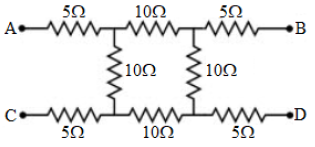
The equivalent resistance between the terminals A and D in the following circuit is
Answer & explanation
Correct answer: option 2
The correct answer is Option (2) → \( 20\,\Omega \)
A resistor joined to a terminal that is left open carries no current. So it plays no part in the resistance between A and D. Resistors in series add, and two equal resistors \( R \) in parallel give \( R/2 \).
From the figure, the \( 5\,\Omega \) resistors at B and at C end on open terminals and carry no current. Take the part between the junction after the \( 5\,\Omega \) at A and the junction before the \( 5\,\Omega \) at D. It has two paths:
the upper \( 10\,\Omega \) and then the right vertical \( 10\,\Omega \): \( 20\,\Omega \)
the left vertical \( 10\,\Omega \) and then the lower \( 10\,\Omega \): \( 20\,\Omega \)
The two equal paths are in parallel:
\( \begin{aligned} R_p &= \frac{20\times20}{20+20}\,\Omega \\ &= 10\,\Omega \end{aligned} \)
Adding the \( 5\,\Omega \) resistors at A and at D in series:
\( \begin{aligned} R_{AD} &= 5\,\Omega+R_p+5\,\Omega \\ &= (5+10+5)\,\Omega \\ &= 20\,\Omega \end{aligned} \)