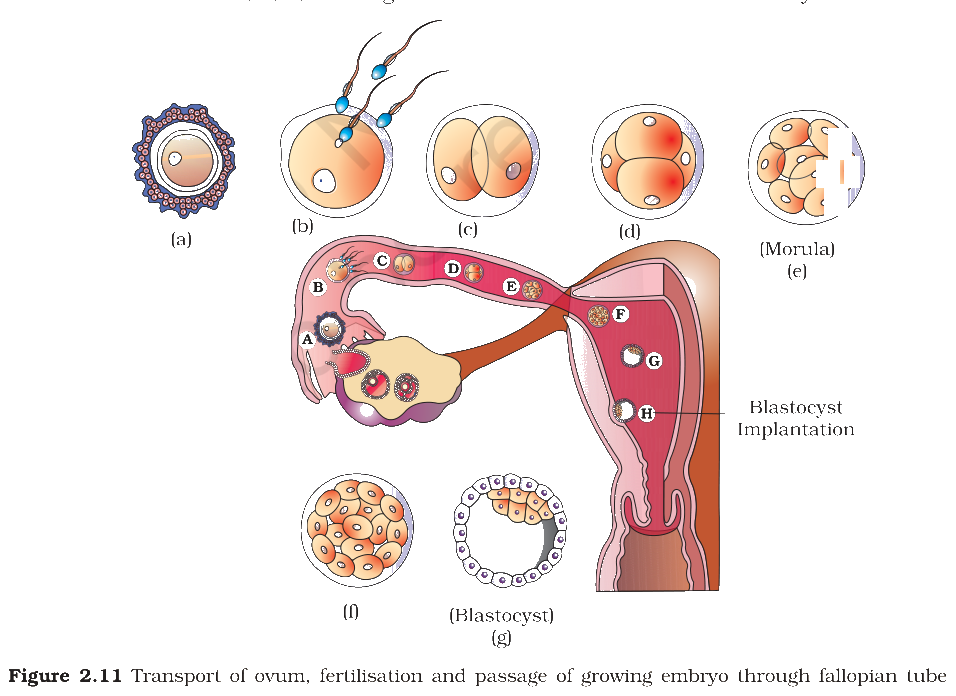
Arrange the following stages in sequence of their occurrence during human reproduction:
(A) Implantation
(B) Cleavage
(C) Blastocyst
(D) Zygote
Choose the correct answer from the options given below:
Answer & explanation
Correct answer: option 2
The correct answer is Option (2) → (D), (B), (C), (A)
(D) Zygote — first. The haploid nuclei of the sperm and the ovum fuse in the ampullary region of the fallopian tube. This forms a diploid zygote, the first cell of the new individual.
(B) Cleavage — second. The zygote starts mitotic divisions as it moves through the isthmus towards the uterus. It forms 2, 4, 8 and 16 cells called blastomeres; the embryo with 8 to 16 blastomeres is the morula.
(C) Blastocyst — third. The morula divides further and turns into a blastocyst as it moves into the uterus. Its cells form an outer trophoblast and an inner cell mass.
(A) Implantation — last. The trophoblast attaches to the endometrium, and the blastocyst becomes embedded in the wall of the uterus. Implantation leads to pregnancy.
NCERT Extract:
Fertilisation and Implantation – “… The mitotic division starts as the zygote moves through the isthmus of the oviduct called cleavage towards the uterus (Figure 2.11) and forms 2, 4, 8, 16 daughter cells called blastomeres. The embryo with 8 to 16 blastomeres is called a morula (Figure 2.11e). The morula continues to divide and transforms into blastocyst (Figure 2.11g) as it moves further into the uterus. The blastomeres in the blastocyst are arranged into an outer layer called trophoblast and an inner group of cells attached to trophoblast called the inner cell mass. The trophoblast layer then gets attached to the endometrium and the inner cell mass gets differentiated as the embryo. After attachment, the uterine cells divide rapidly and covers the blastocyst. As a result, the blastocyst becomes embedded in the endometrium of the uterus (Figure 2.11 step H). This is called implantation and it leads to pregnancy.”