
Which one of the following is not a restriction site in pBR322 vector?
Answer & explanation
Correct answer: option 4
The correct answer is Option (4) → Hind II
pBR322 is a cloning vector used in E. coli. Its map shows the restriction sites Hind III, EcoR I, BamH I, Sal I, Pvu II, Pst I and Cla I, along with ori, rop and the resistance genes ampR and tetR.
(1) Hind III — A restriction site in pBR322. It is marked on the vector map.
(2) Pvu II — A restriction site in pBR322. It is marked on the vector map.
(3) EcoR I — A restriction site in pBR322. It is marked on the vector map.
(4) Hind II — Not a restriction site in pBR322. Hind II is a real enzyme. In fact, it was the first restriction endonuclease to be isolated. But it is not one of the sites marked on pBR322. Do not confuse it with Hind III, which is.
Note: A similar question was also asked in CUET (UG) 2026 on 22-05-2026 (Slot 2).
NCERT Extract:
Cloning Vectors – “… (iii) Cloning sites: In order to link the alien DNA, the vector needs to have very few, preferably single, recognition sites for the commonly used restriction enzymes. Presence of more than one recognition sites within the vector will generate several fragments, which will complicate the gene cloning (Figure 9.4). The ligation of alien DNA is carried out at a restriction site present in one of the two antibiotic resistance genes. For example, you can ligate a foreign DNA at the BamH I site of tetracycline resistance gene in the vector pBR322.”
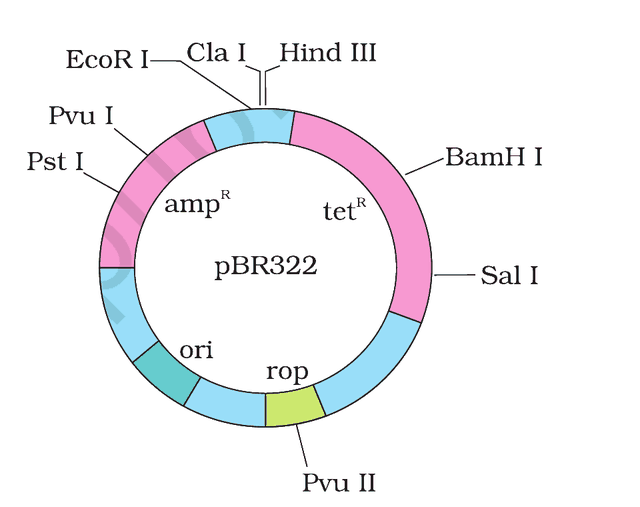
Figure 9.4 E. coli cloning vector pBR322 showing restriction sites (Hind III, EcoR I, BamH I, Sal I, Pvu II, Pst I, Cla I), ori and antibiotic resistance genes (ampR and tetR)