
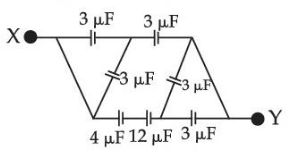
The equivalent capacitance between points X and Y in the figure given below is:
Answer & explanation
Correct answer: option 2
The correct answer is Option (2) → \( 4\,\mu\mathrm{F} \)
Capacitors in parallel add, \( C = C_1 + C_2 \); capacitors in series combine as \( \frac{1}{C} = \frac{1}{C_1}+\frac{1}{C_2} \). First find which points are joined by plain wire. The sloping wire at the left joins X to the left end of the bottom row, and the sloping wire at the right joins the right end of the top row to Y. Call the junction between the two top capacitors P and the junction between the 12 μF and the last 3 μF capacitors N.
Upper route (through P)
Between X and P: the top 3 μF and the sloping 3 μF are in parallel, \( 3+3 = 6\,\mu\mathrm{F} \).
Between P and Y: a single 3 μF capacitor.
\( \displaystyle C_{\mathrm{up}} = \frac{6\times3}{6+3} = 2\,\mu\mathrm{F} \)
Lower route (through N)
Between X and N: 4 μF and 12 μF in series.
\( \displaystyle \frac{4\times12}{4+12} = 3\,\mu\mathrm{F} \)
Between N and Y: the sloping 3 μF and the bottom 3 μF are in parallel, \( 3+3 = 6\,\mu\mathrm{F} \).
\( \displaystyle C_{\mathrm{low}} = \frac{3\times6}{3+6} = 2\,\mu\mathrm{F} \)
Both routes join X and Y, so they are in parallel.
\( C_{XY} = 2 + 2 = 4\,\mu\mathrm{F} \)