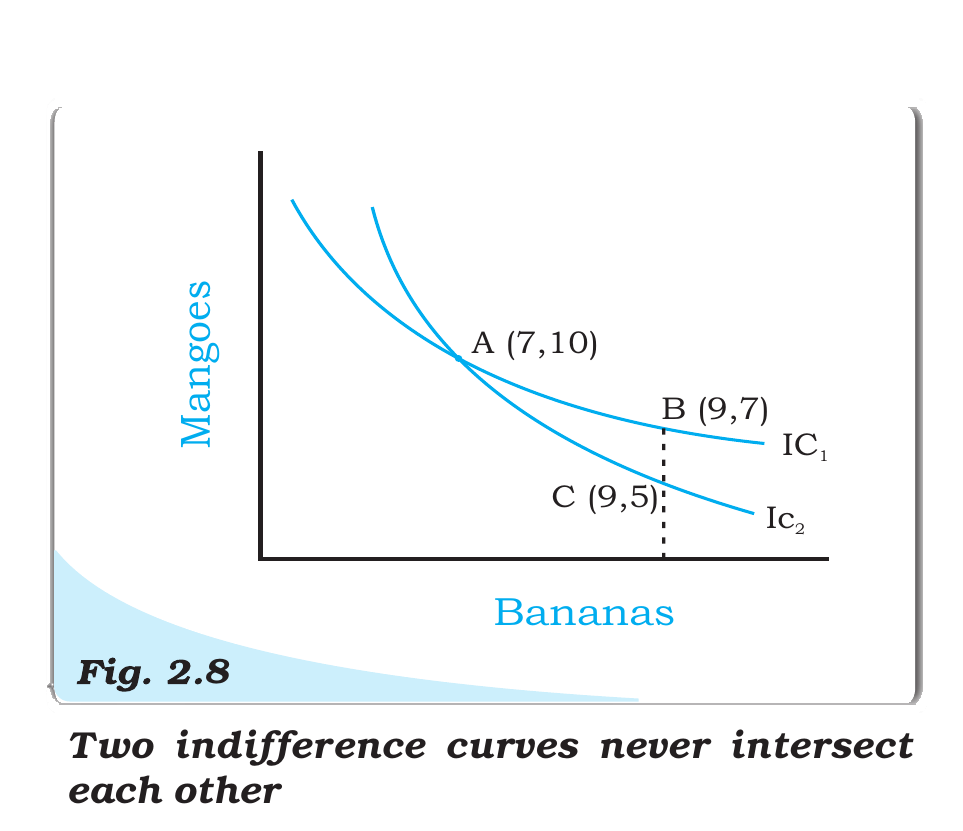
Two indifference curves can never intersect each other as ______.
Answer & explanation
Correct answer: option 2
The correct answer is Option (2) → They give different levels of satisfaction.
All points on one indifference curve give the same satisfaction, and a higher curve gives more satisfaction. So two curves stand for two different levels. If they crossed, the point where they meet would have to be on both levels.
Suppose bundle A is on both curves, B is on the first curve and C is on the second. Then B and C would give the same satisfaction as A, and so the same as each other. But B has more mangoes than C with the same bananas, so the consumer is better off at B. This result is absurd, so the curves cannot cross.
Option (1) They give the same level of satisfaction. — Incorrect. The same level of satisfaction holds for points on one curve. Two different curves give different levels.
Option (2) They give different levels of satisfaction. — Correct. One bundle cannot give two levels of satisfaction at once.
Option (3) They are concave to the origin. — Incorrect. The usual indifference curve is convex to the origin. A shape cannot explain why curves do not cross.
Option (4) They are convex to the origin. — Incorrect. This is true of the usual curve. It says nothing about why two curves cannot cross.
NCERT (2026-27): “2. Higher indifference curve gives greater level of utility: … A higher indifference curve consisting of combinations with more of mangoes, or more of bananas, or more of both, will represent combinations that give higher level of satisfaction. 3. Two indifference curves never intersect each other: Two indifference curves intersecting each other will lead to conflicting results. To explain this, let us allow two indifference curves to intersect each other as shown in the figure 2.8. As points A and B lie on the same indifference curve IC1, utilities derived from combination A and combination B will give the same level of satisfaction. Similarly, as points A and C lie on the same indifference curve IC2, utility derived from combination A and from combination C will give the same level of satisfaction. From this, it follows that utility from point B and from point C will also be the same. But this is clearly an absurd result, as on point B, the consumer gets a greater number of mangoes with the same quantity of bananas. So consumer is better off at point B than at point C. Thus, it is clear that intersecting indifference curves will lead to conflicting results. Thus, two indifference curves cannot intersect each other.… Shape of an Indifference Curve It may be mentioned that the law of Diminishing Marginal Rate of Substitution causes an indifference curve to be convex to the origin. This is the most common shape of an indifference curve.…”
|