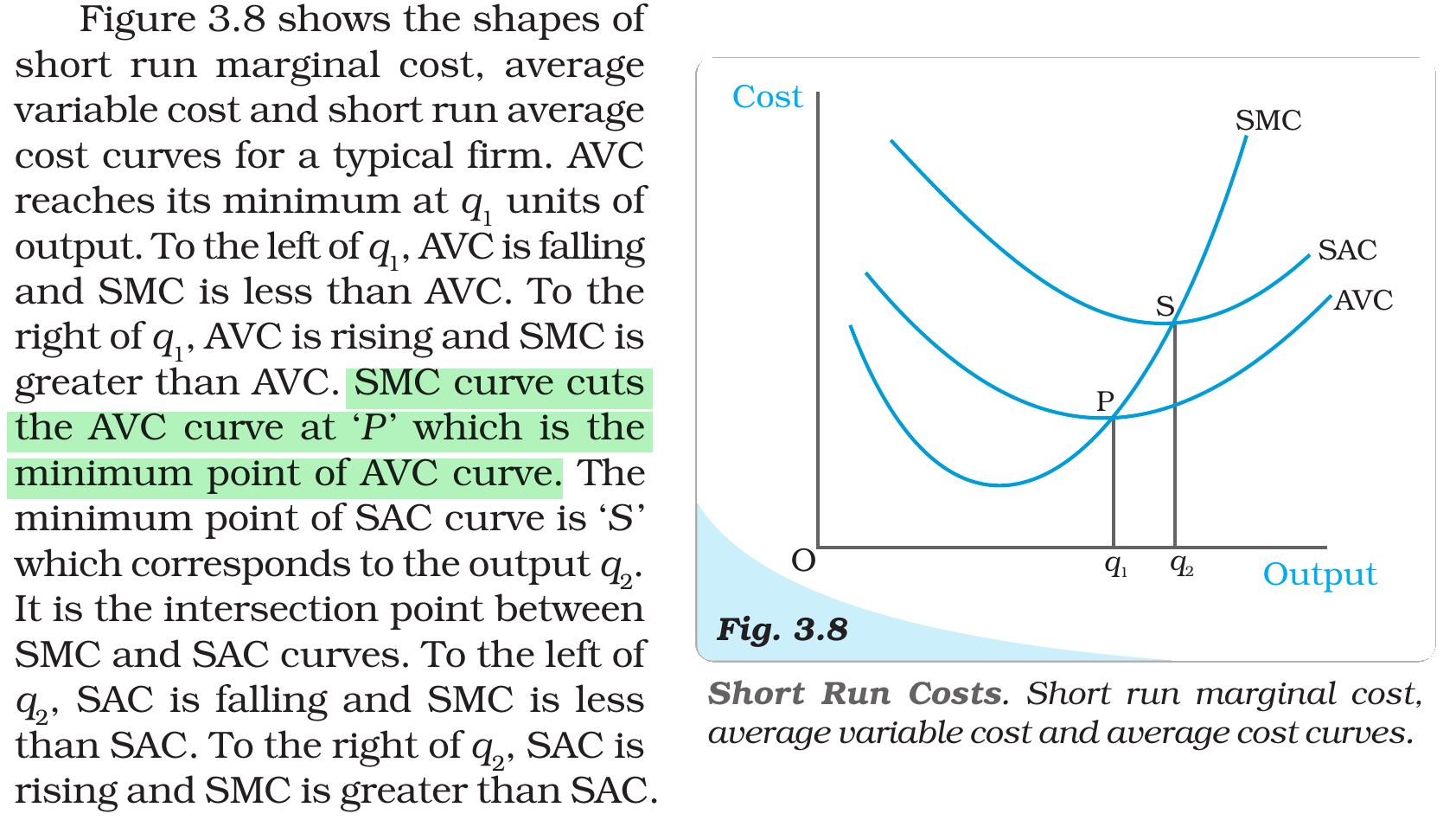
Which statement is incorrect in the context of relationship between AVC and SMC?
Answer & explanation
Correct answer: option 4
The correct answer is Option (4) → SMC curve cuts the AVC curve from below at the minimum point of SMC.
Short run marginal cost (SMC) meets average variable cost (AVC) at the minimum point of AVC, while Option (4) puts this at the minimum of SMC. AVC is the variable cost per unit. SMC is the cost of one more unit. An SMC below the average pulls AVC down, and an SMC above it pulls AVC up.
Option (1) As long as AVC is falling, SMC must be less than the AVC. — True. The extra unit costs less than the average, so it pulls the average down.
Option (2) SMC curve cuts the AVC curve from below at the minimum point of AVC. — True. AVC stops falling where SMC rises up to it. This is the lowest point of AVC.
Option (3) As AVC rises, SMC must be greater than the AVC. — True. The extra unit costs more than the average, so it pulls the average up.
Option (4) SMC curve cuts the AVC curve from below at the minimum point of SMC. — False. SMC reaches its own lowest point earlier, while it is still below AVC. It then rises and cuts AVC later, at the minimum point of AVC.
NCERT (2026-27): “Shapes of the Short Run Cost Curves … For the first unit of output, it is easy to check that SMC and AVC are the same. So both SMC and AVC curves start from the same point. Then, as output increases, SMC falls. AVC being the average of marginal costs, also falls, but falls less than SMC. Then, after a point, SMC starts rising. AVC, however, continues to fall as long as the value of SMC remains less than the prevailing value of AVC. Once the SMC has risen sufficiently, its value becomes greater than the value of AVC. The AVC then starts rising. The AVC curve is therefore ‘U’-shaped. As long as AVC is falling, SMC must be less than the AVC. As AVC rises, SMC must be greater than the AVC. So the SMC curve cuts the AVC curve from below at the minimum point of AVC.”
|