Which of the following compound is most reactive towards nucleophilic addition reaction?
Answer & explanation
Correct answer: option 4
The correct answer is Option (4) → Formaldehyde
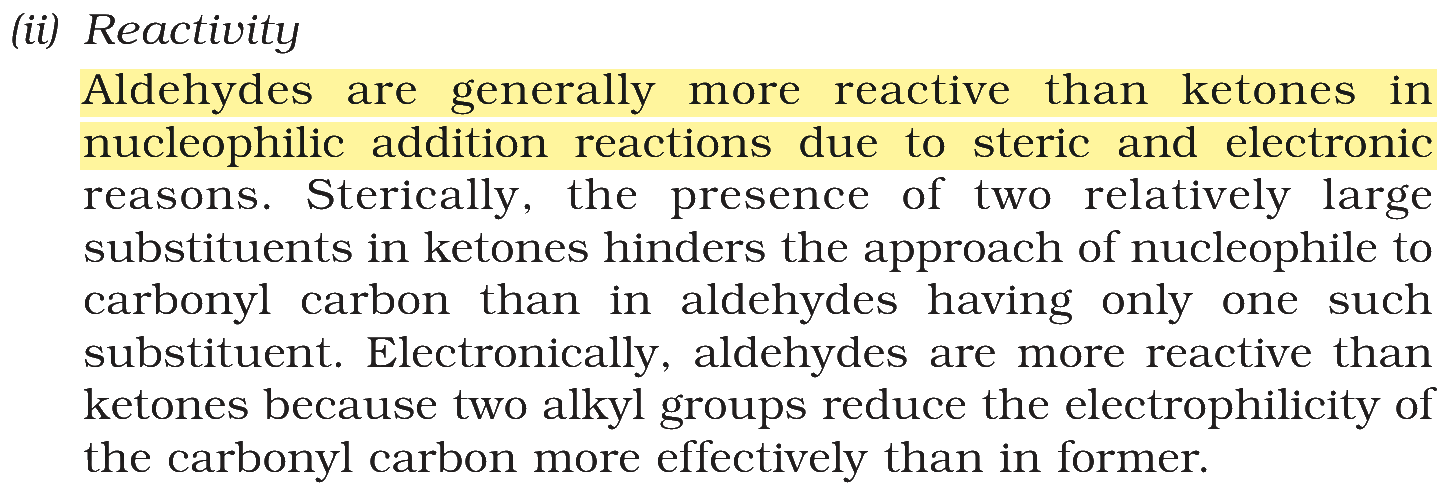
In nucleophilic addition the nucleophile attacks the electrophilic carbonyl carbon. The reactivity depends on two factors:
Electronic: alkyl groups release electrons and reduce the positive charge on the carbonyl carbon; an aryl group does the same by resonance. Fewer such groups means a more electrophilic carbon.
Steric: bulky groups around the carbonyl carbon hinder the approach of the nucleophile.
Both factors favour the compound with the smallest groups on C=O. Formaldehyde, HCHO, has two hydrogen atoms and no alkyl group: it is the least crowded and the most electrophilic. In decreasing order of reactivity:
\( \displaystyle \ce{HCHO} \gt \ce{CH3CHO} \gt \ce{CH3COCH3} \gt \ce{C6H5COCH3} \)
So the most reactive is formaldehyde.
Why the other options are incorrect
Option (1) Acetone — Incorrect. It has two methyl groups, which reduce the electrophilicity of the carbonyl carbon and hinder attack.
Option (2) Acetophenone — Incorrect. The phenyl ring conjugates with C=O and lowers its positive charge, and with a methyl group as well it is the least reactive of the four.
Option (3) Acetaldehyde — Incorrect. As an aldehyde it is more reactive than the ketones, but its one methyl group makes it less reactive than formaldehyde.
NCERT (2026-27 edition):
Reactivity